
How to Write a Business Proposal: Examples and a Template
Learn how to write a business proposal: what to clarify first, which sections to include, and how to present price, timeline, and terms. Includes two examples — for services and installation work — a reusable template, sample emails, and steps in if.team.
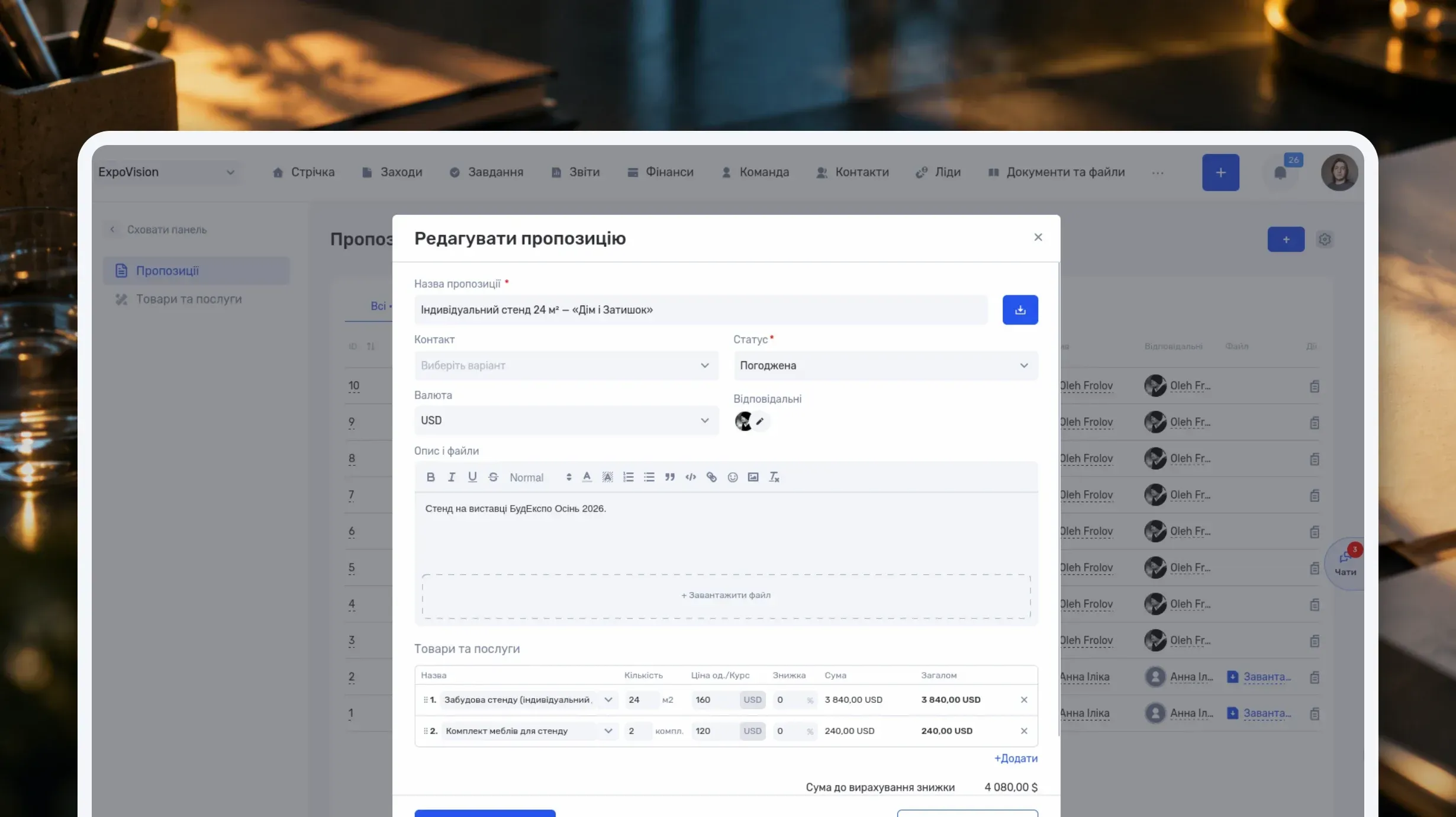
A business proposal is a document or message that explains what you are offering a client, what they will receive, how much it costs, and the terms of the work. It gives the client the information they need to decide whether the solution, price, and conditions suit them.
Imagine a company looking for an agency to build a new website. One proposal offers a “personalized approach, modern design, and comprehensive solution” for $12,000. Another specifies the page types, catalog work, approval deadlines, price of each stage, and exclusions. The second is much easier to compare with the company's requirements: the client can see what they are paying for and what needs discussing before work begins.
This guide explains how to write a business proposal, prepare the cost breakdown, and give the client a document they can evaluate. It includes two examples and a reusable template, followed by a walkthrough in if.team. The company names, schedules, amounts, and terms are illustrative. They are not prices charged by if.team or its clients.
What is a business proposal, and when do you need one?
A client asks for a service, but the service name rarely defines its full scope. “Building a website” might mean five pages or a large catalog, client-supplied copy or professional writing, a straightforward launch or a complex migration. A proposal turns that broad request into specific terms the parties can discuss.
The document also needs to work inside the client's company. Your contact may forward it to a director, finance manager, or technical specialist. Those people weren't in the meeting, so they need to understand the offer without hearing the entire conversation.
A proposal after discussing the requirements
Once you understand the need, start with what you recommend for this particular client. For example: “We'll build a website with a catalog of up to 30 products, so your sales team can share current product information and receive inquiries through a form.” Then explain the scope, timing, and terms.
You don't need to introduce every service your company provides. If the client asked for a website, your experience in events or mobile apps is relevant only if it helps them assess this project.
Check that each proposed service is needed. Replacing the client name in a template isn't enough.
An introductory partnership proposal
A first email to a potential partner usually has a more limited purpose: establish interest and start a conversation. You don't yet know all the requirements, so a detailed estimate can give a false impression of certainty.
Explain whom you help, what work you do, why you contacted this company, and what you would like to discuss. If you have a relevant project in your portfolio, link to one example. Don't make the recipient work through a general presentation to discover why you wrote.
If they are interested, clarify the requirements and prepare a tailored proposal with a scope, price, and terms.
How is a proposal different from a price list or cost estimate?
A price list gives standard prices. An estimate shows the work, quantities, and amounts behind a calculation. A proposal connects the proposed solution with that calculation and the terms of delivery.
An agency's price list might state an hourly development rate. Its estimate might list the hours needed for a particular catalog. The proposal explains what that catalog will include, what the client must provide, when it will be ready, and how changes will be approved.
| Document | What it explains | What may be missing |
|---|---|---|
| Price list | Standard products or services and their unit prices | The scope and terms of a specific order |
| Cost estimate | How the total was calculated | The rationale, approval process, and next step |
| Business proposal | What is offered to this client, at what price, and on what terms | Details the parties still need to confirm before starting |
These can all be parts of one file. A short email with a table may be enough for a small job. For a complex project, put the main proposal first and the detailed specification in an appendix. Make clear which documents should be read together.
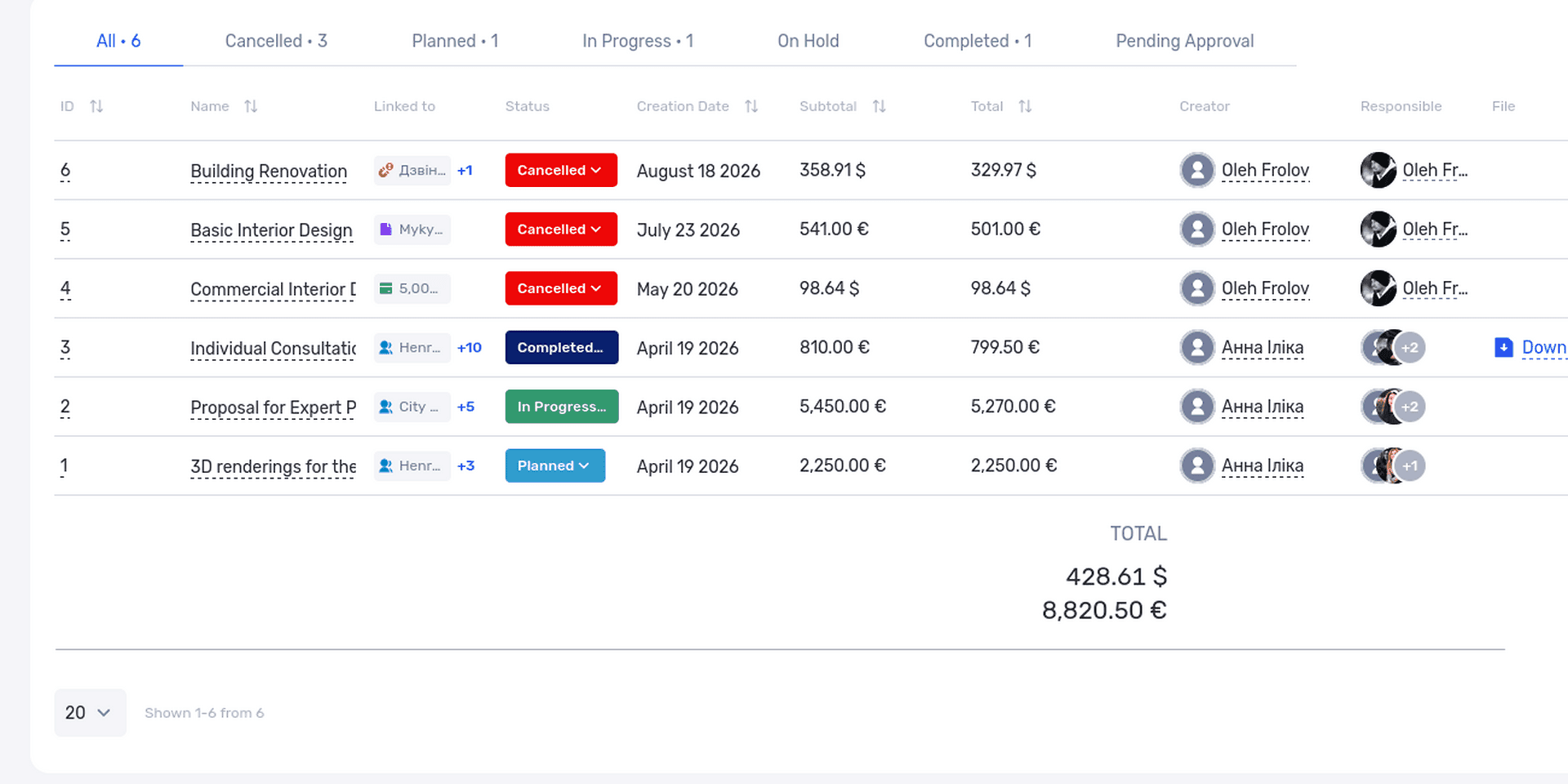
The Quotes list keeps proposal records, statuses, and totals together; each proposal also needs a clear scope and terms.
What to clarify before writing a proposal
Understand the client's task before you start writing. Gather the available information from the brief and use a meeting to resolve gaps. Identify anything still undecided, along with the assumptions used in the estimate.
For our example, consider Obrii, an equipment supplier that needs a website with a catalog. The agency must establish whether this is a showcase that sends inquiries to sales or an online store with payments, stock levels, and integrations. Online payments, inventory tracking, and integrations require separate estimates.
The task, deliverables, and acceptance criteria
Ask what needs to change when the work is complete. “Update the website” expresses an intention. “Create an up-to-date catalog so the sales team can send clients links to products” defines a more concrete task.
Next, identify what you will hand over. For a website, that may include published pages, a working inquiry form, content-management access, and instructions. For an installation, it may be installed equipment and an agreed set of checks. Decide how completion will be verified: for example, the form sends an inquiry and the sales manager receives the product name and buyer's contact details.
Don't confuse the deliverable with the hoped-for business impact. An agency can take responsibility for a working form, but inquiry volume also depends on traffic, the product, and sales activity. If you promise a performance metric, explain how it will be measured and under what conditions.
Scope and source materials
Establish the number of pages, products, rooms, equipment units, or other measurable components. Ask what is already available: copy, photos, drawings, access credentials, or technical requirements.
For Obrii, a key question is who will populate the catalog. The agency could enter 30 products once from a prepared spreadsheet, or it could also write descriptions, process photos, and clarify specifications. Those are different jobs and should not disappear behind the word “content.”
If information is missing, provide a preliminary estimate with explicit assumptions or propose a separate discovery or site-survey stage. For example: “This estimate covers 30 products and one language. We'll confirm the final scope after reviewing the product spreadsheet.” The client can then see what drives the price.
Timing, budget, and approvals
Ask why the client wants a particular date. Launching before a trade show is a different constraint from “next month would be nice.” Knowing the reason makes it easier to propose a smaller first version or explain why the full scope won't fit.
The budget helps determine the solution. If it is below the estimate for the full scope, discuss what can be deferred, simplified, or prepared by the client. Don't quietly remove work while keeping the same package name.
Establish who gathers feedback and who makes decisions. When three people approve a design independently, conflicting comments can send the team back to completed stages. Suggest one contact who provides a consolidated set of comments.
What to include in a business proposal
A useful structure follows the client's questions: Have you understood the problem? What will you do? What will I receive? What will it cost? When will it be ready? What do you need to start? Following that sequence makes the offer easier to assess.
Not every section needs its own page. In a short proposal, one paragraph may explain the task, and a few points may cover timing and payment. Include the detail the buyer needs to make a decision.
A specific title and short summary
Instead of simply “Business proposal,” name the work: “Catalog website for Obrii.” Add the date and version below the title so revised documents can be distinguished.
Start with the essentials: the solution, main deliverable, total price, and expected timing. If the price is preliminary, say so immediately. The client shouldn't have to reach the end of a long presentation to find the key terms.
Don't open with your company history unless it is needed to assess the offer. Demonstrate experience later through a relevant project, the proposed team, or an explanation of your approach.
The client's task and your proposed solution
Briefly describe the starting point. For example: “The catalog is spread across several files, and sales managers send photos and specifications manually. The company needs one current version buyers can access.” This lets the client check that you have understood the need.
Then describe the solution: a catalog website that the client's team can update. State its boundaries: an inquiry form rather than online payment, one language, and a defined number of products.
There is no need to dramatize the situation or invent losses. “You're losing thousands every day” undermines trust when there is no evidence behind it. Identify the known problem and explain how the work addresses it.
Scope and deliverables for each stage
Explain what the work involves. Replace “design” with “desktop and mobile layouts for five page types.” Replace “testing” with “checking the inquiry form, navigation, and display of the agreed page types.”
State what is delivered after each stage: a structure, designs, installed equipment, a report, or access credentials. This shows what each part of the price covers.
Move complex technical details into a specification if needed. Keep the main text understandable to the person approving the budget. They should know what they are buying even if they don't use your team's internal terminology.
Price, payment schedule, and additional costs
Show the total and how it is made up. Include quantities and unit prices where appropriate. For a fixed-price stage, name the deliverable and its scope limits.
Specify the currency and whether sales tax or other charges are included. The client needs to see the amount payable. Check that the wording matches the circumstances of the order.
Place the payment schedule beside the price: amounts, percentages, and the milestones that trigger them. List third-party costs separately where applicable, such as domains, hosting, licenses, delivery, or equipment rental. Don't mix them with your fee.
Timing and start conditions
“Six weeks” needs a starting point. From sending the proposal, receiving the deposit, or receiving the materials? On a project with several participants, those may be different dates.
List what is needed to start: agreed scope, source materials, access, and the required payment. If timing depends on client responses, explain how much time is allowed for approvals and how delays will affect the schedule.
A separate plan can show the detailed sequence. Our guide to Gantt charts explains how to make timelines and dependencies clear. The proposal itself needs enough detail for the client to approve the work.
Exclusions
Explicit exclusions help prevent mismatched expectations. For a website, these might be translation, photography, or integration with an accounting system. For installation work, they might include restoring finishes or work in areas that have not been surveyed.
Evidence of relevant experience
Choose an example that fits the client's task. One case study with a comparable scope and a clear explanation of your team's role is more useful than a long row of unexplained logos. Don't claim client results you haven't verified.
A concrete next step
End with a specific action: confirm the scope, choose an option, or schedule a short meeting. “We look forward to working with you” is a polite closing, but it does not tell the reader what to do next.
How to write a clear business proposal
The reader needs to find the terms quickly and assess them. Each sentence should explain the solution or help verify it. Replace judgments such as “high-quality” with details the client can use to evaluate quality.
A 1997 Nielsen Norman Group study found that concise, scannable, objective web content was easier to use than promotional writing. It was not a study of proposal sales, but the principle is useful here: make scope, price, and terms easy to find.
Replace broad promises with specific work
“Comprehensive support” does not explain whether meetings, revisions, and technical assistance are included. “Two rounds of design revisions and a weekly meeting of up to 30 minutes” sets a clear boundary.
Being specific doesn't mean listing every internal action. The client doesn't need to know how often a designer opens a file. They need to understand the deliverable, approval process, and rules for changing the scope.
| Vague wording | A more specific alternative |
|---|---|
| Website content | Entering up to 30 products from the client's prepared spreadsheet |
| Unlimited possibilities for your business | A catalog, search, and product inquiry form |
| We'll accommodate all your requests | Two rounds of consolidated design revisions within the approved structure |
| Fast installation | Up to five working days after the premises and equipment are ready |
Explain units and options
If you say “one page,” clarify whether you mean a unique layout type or each published page. “One kit” also needs a contents list if the buyer doesn't know what it includes.
Options are useful when they represent meaningful choices: a basic catalog or one with an integration; installation of the client's equipment or supply and installation together. Show how each changes the deliverable, price, and timing.
Don't create three packages just to fill three columns. If one scope fits the request, explain it. Put optional extras below and state clearly that they are not included in the total.
Business proposal example for services
Below is an illustrative proposal for Obrii's website. It shows how to combine the explanation and cost breakdown. In a real document, use your own business details and confirm the scope, schedule, and tax treatment. In this example, no sales tax applies to these services, and the amounts shown are the final prices.
Proposal for Obrii
Equipment catalog website for Obrii
Supplier: Forma, a fictional web agency.
Version: 1.0.
Prepared: October 9, 2026.
Valid through: October 23, 2026, inclusive. The start date will be agreed separately.
What we propose
We'll build an English-language website with a catalog of up to 30 products. Buyers will be able to view specifications and submit inquiries through a form. Your sales team will have one current catalog to share instead of several separate files.
The first release will include five page types: home, catalog, product details, about, and contact. Product pages will use a shared template. Online payments and automated stock synchronization with your accounting system are not included.
Scope and price
| Stage | Deliverables | Price, USD |
|---|---|---|
| Requirements and structure | Feature description, sitemap, and requirements for source materials | 1,500 |
| Design | Desktop and mobile layouts for five page types | 3,000 |
| Development | A staging website with a catalog, search, inquiry form, and content management | 5,000 |
| Content entry | Up to 30 products from the client's prepared spreadsheet and photos | 1,000 |
| Testing and launch | A tested website on the agreed domain, access credentials, and one training session of up to 60 minutes | 1,500 |
| Total | All work listed above | 12,000 |
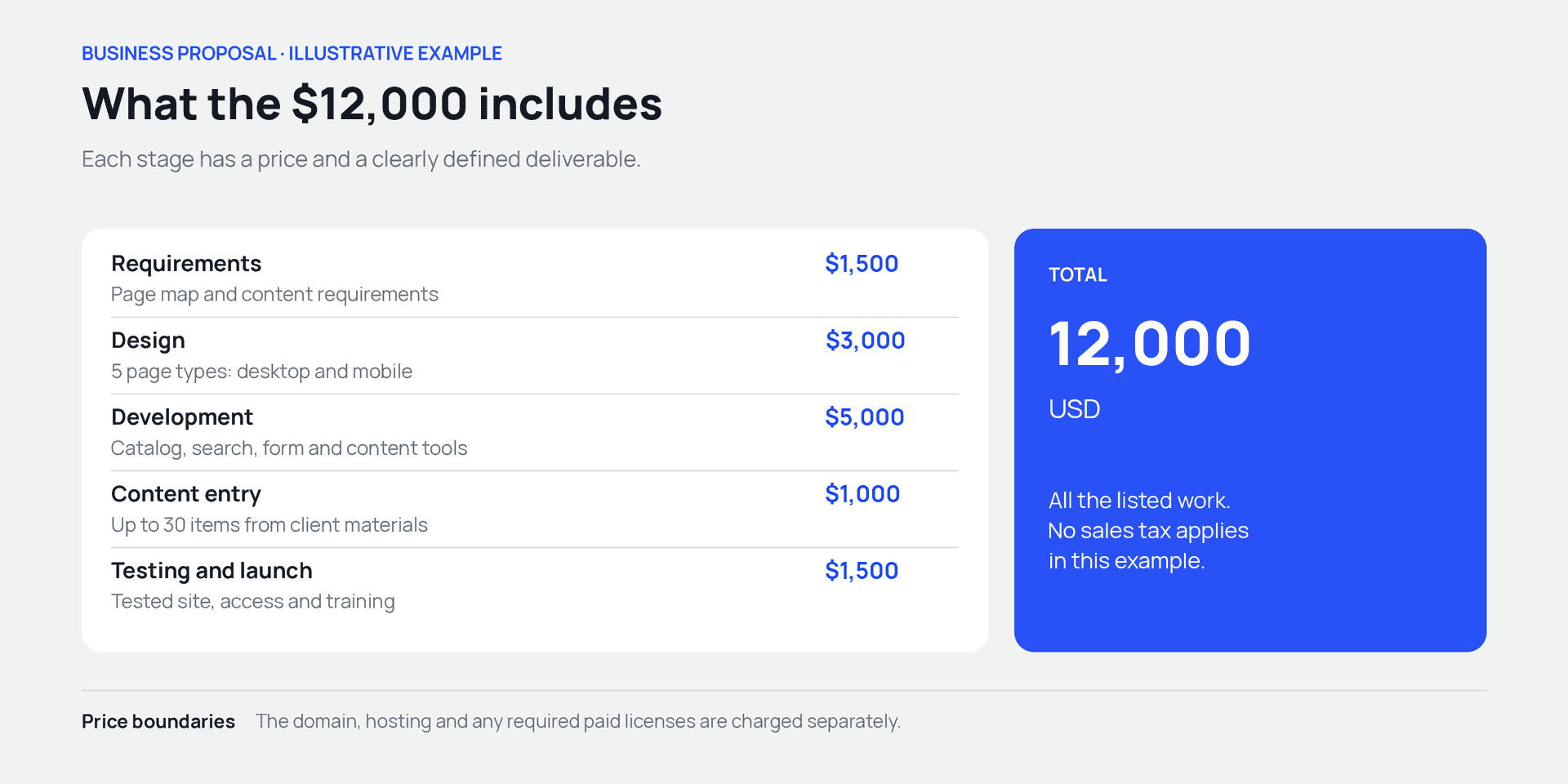
The example proposal allocates $12,000 across five stages with defined deliverables.
Timeline
We plan six working weeks from the agreed start: week one for requirements; weeks two and three for design; weeks four and five for development and content entry; and week six for testing and launch.
Work can begin once the scope is agreed and we have received the deposit, logo, copy, product spreadsheet, and photos. The schedule allows two working days for the client to return consolidated feedback on each submission. If approvals or materials are delayed, we will review the launch date together.
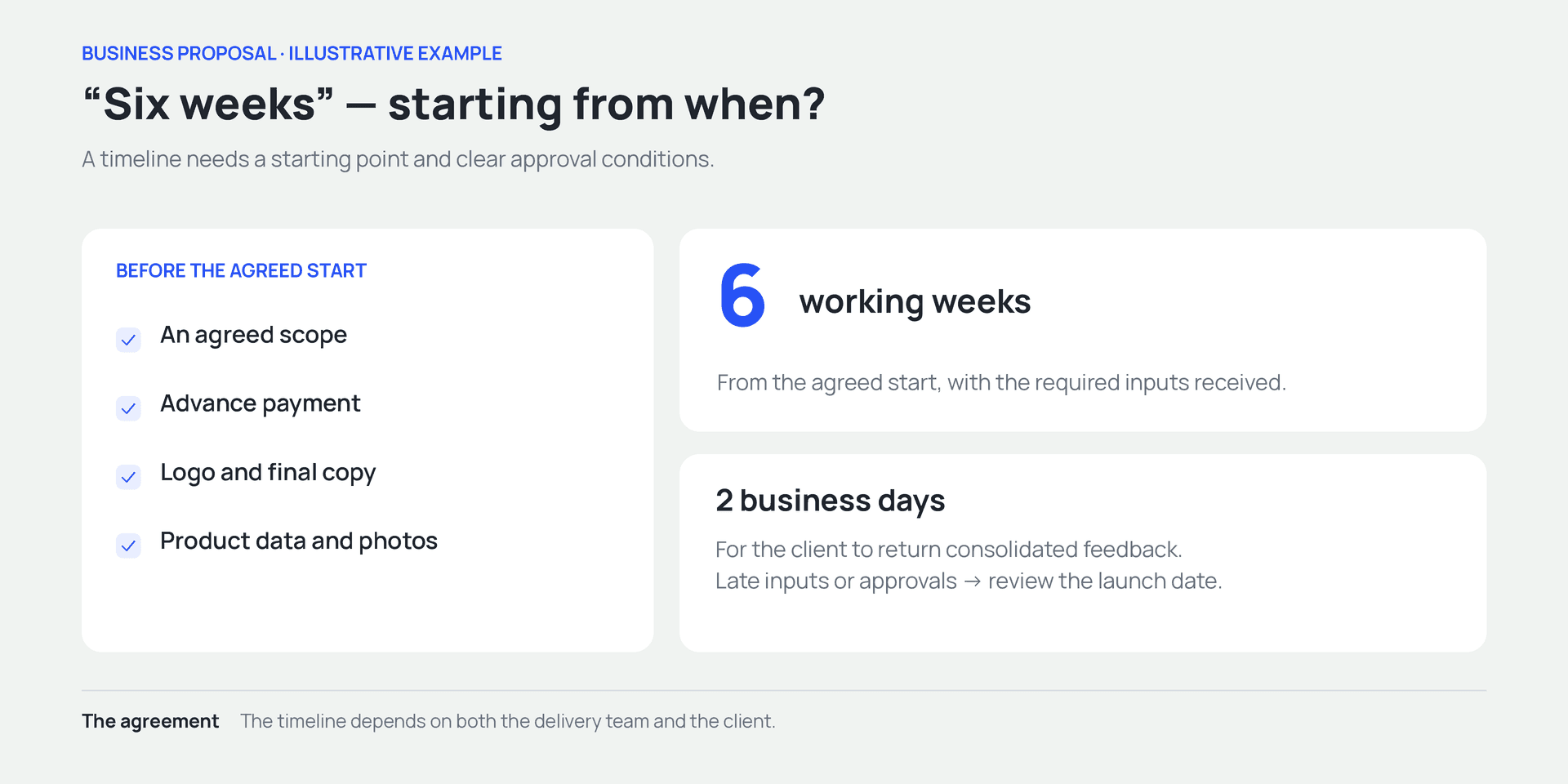
The six-week timeline begins at the agreed start once the starting conditions are met.
Revisions and acceptance
The price includes two rounds of design revisions within the approved structure. One round means one consolidated list from the designated contact. New page types, a second language, or changes to approved functionality will be estimated separately.
Before launch, we will test navigation, search, the inquiry form, and the agreed page types in the current stable versions of Chrome, Firefox, and Safari on the agreed desktop and mobile configurations. We will define the test checklist during the requirements stage. Any failure to meet the agreed scope will be corrected before handover.
Payment
A 50% deposit, $6,000, is due before work begins. The second payment of 30%, $3,600, is due after design approval. The remaining 20%, $2,400, is due after the agreed scope has been tested in staging and before the site is moved to the main domain.
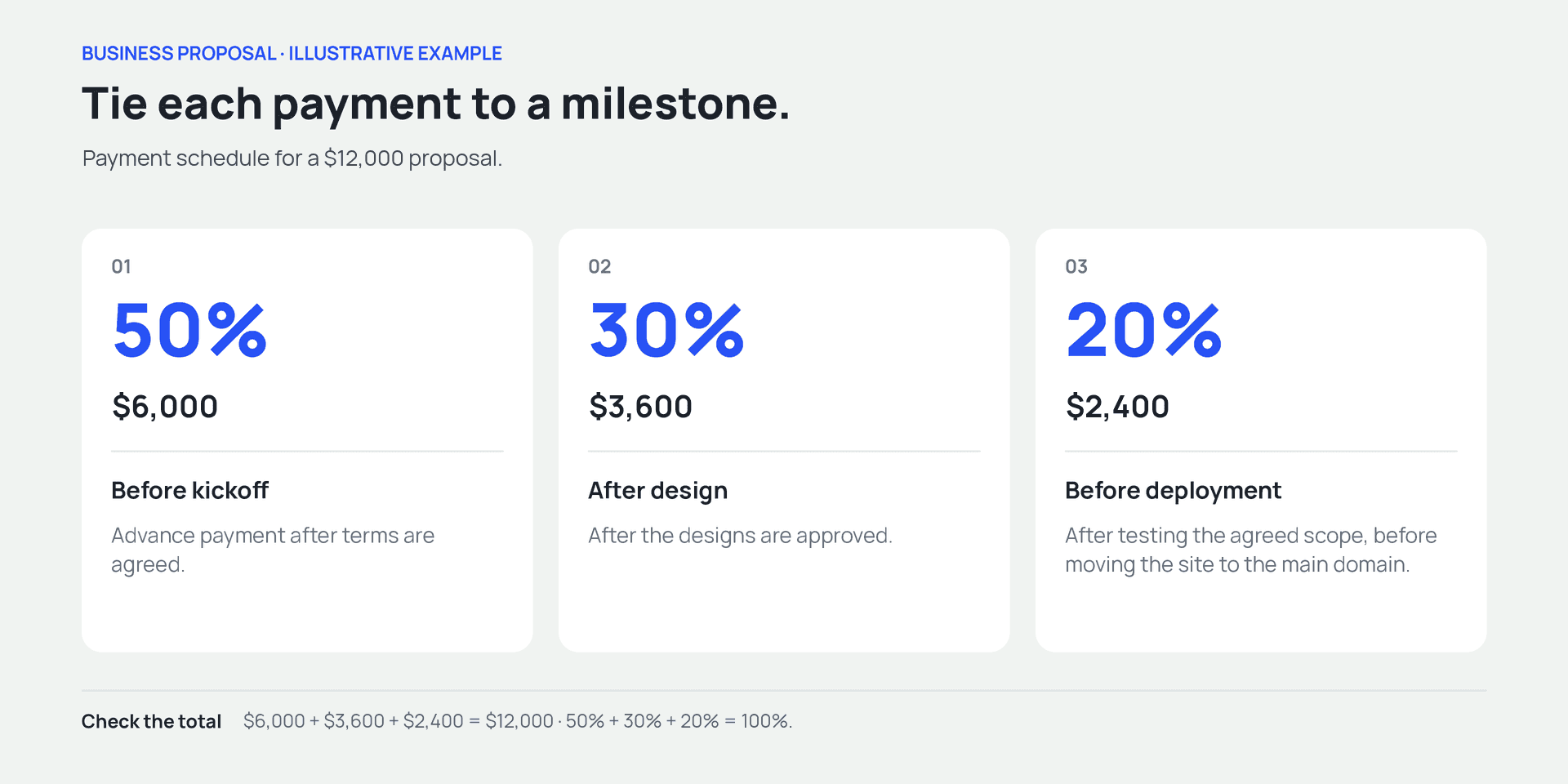
The payment schedule links each part of the price to a specific project milestone.
Exclusions
The domain, hosting, and any required third-party paid licenses are charged separately. The agency's scope does not include photography, copywriting, translation, advertising, migration from the old system, or accounting software integration.
Before starting, we will confirm which external services are required, who pays for them, and who owns the accounts. Ongoing post-launch support will be discussed separately.
Next step
Please confirm whether five page types and a catalog of up to 30 products meet your needs. We will then review the materials, agree on a start date, and prepare the documents needed to commission the work.
The proposal is managed by Forma's account manager. Reply using the contact details in the accompanying email.
How to adapt this service proposal example
Start with the scope. Five page types and 30 products are different units: all products use a shared product-page template. If your client needs distinct layouts for different categories, include them in the design and development estimates.
Check two totals when adapting the example: the sum of the stage prices and the sum of the payments. Both are $12,000 here. If you remove the $1,000 content-entry stage, change the total to $11,000 and recalculate the installments as $5,500, $3,300, and $2,200. That keeps the scope change consistent throughout the document.
The structure can also work for design, marketing, consulting, or content services. Replace the deliverables and units of scope. For a monthly service, replace one-off stages with the service period, recurring deliverables, meeting allowance, and process for reviewing workload.
Business proposal example for installation work
An engineering or installation project needs a clear separation between equipment, materials, and labor. Two proposals with the same total may include different device models, cable lengths, and site-access assumptions. Without those details, the comparison is superficial.
The following preliminary proposal covers a local area network installation. It illustrates the structure of an estimate; a real technical scope would be confirmed after a site survey.
Proposal for Prostir's office
Local area network for 12 workstations
Supplier: Kontur, a fictional installation company.
Version: 1.0, dated October 9, 2026.
Valid through: October 16, 2026, inclusive.
Task and solution
We will provide 12 wired network connections within one office. We will install and connect the agreed components, label the lines, and hand over a diagram of the network points with the results of the agreed tests.
The estimate assumes existing accessible cable routes and a total cable length of up to 300 meters. Equipment models, cable category, and the components of each network point must be recorded in the specification before ordering. After surveying the premises, we will confirm the quantities or issue a revised estimate.
Preliminary estimate
| Item | Quantity | Unit price, USD | Amount, USD |
|---|---|---|---|
| Network switch to the agreed specification | 1 unit | 600 | 600 |
| Network-point components to the specification | 12 kits | 45 | 540 |
| Cable to the specification | 300 m | 1.50 | 450 |
| Cable laying along existing accessible routes | 300 m | 2.25 | 675 |
| Installation, connection, and labeling of network points | 12 points | 35 | 420 |
| Configuration and testing to the agreed checklist | 1 package | 315 | 315 |
| Total | — | — | 3,000 |
In this example, the prices include all applicable taxes. Delivery within the city is included. Work and materials not listed above are excluded.
Timeline and site readiness
The work will take up to five working days after the agreed equipment is received and access to the premises is available. We will agree on the crew's start date after delivery is confirmed.
The client will provide access to work areas during the agreed hours and nominate a contact for day-to-day decisions. If other contractors are working on site, we will agree on the sequence before starting.
Payment terms
60% of the confirmed amount is due before equipment is ordered and work begins; 40% is due after completion and the agreed tests. For the current estimate, those payments are $1,800 and $1,200. If the survey changes the scope, we will issue a new version before agreeing on the advance payment.
Exclusions
The estimate does not include creating new concealed cable routes, restoring finishes, electrical power work, connecting an internet service provider, server equipment, or ongoing network administration.
If the survey identifies a need for this work, we will separately agree on the responsible contractors, scope, price, and effect on the schedule. Substitutions for agreed equipment models also require prior approval.
Handover and support
We will provide a list of installed components, a network-point diagram, and the results of the agreed tests. Equipment warranty terms and responsibility for the installation work will be stated separately in the order documents once the models have been selected. The client must receive these terms with the final specification before approval.
Next step
We suggest arranging an office survey. Afterward, we will confirm cable-route lengths, kit contents, equipment models, and the final price.
What to check in an installation proposal
In this example, equipment and materials account for $1,590 and labor for $1,410, totaling $3,000. The split makes it easier to see what changes if the client supplies the equipment or the survey shows a shorter cable run.
Before approval, replace references to a future specification with actual models, characteristics, kit contents, and permitted substitutions. Attach the specification to the final version. The preliminary table lets the client assess the budget, but it does not yet let them compare the equipment with other offers.
Check units as well. If cable is priced per meter and installation per point, explain the boundary of each activity to avoid double-counting. In our example, laying cable and connecting network points are separate.
It is useful to link this kind of proposal to the future project. The LedLab electrical company's case study shows how the team builds proposals from catalog items and uses the approved scope as the basis for planning in if.team. The illustrative estimate above is unrelated to LedLab's prices.
A business proposal template for your project
Copy the outline below into your document and fill it in. Replace the bracketed text with details of the actual job, then remove the instructions. If a section is unnecessary, remove the heading rather than leaving it empty.
A standard template gives the team a shared structure. The solution, scope, and limitations still need to reflect the agreement with each client.
Copy-and-fill template
Download the editable template or copy the text below. Replace the bracketed fields before sending it to a client.
[Solution name] for [client company]
Supplier: [Company name and required business details].
Date and version: [Date and version number].
Contact: [Name, role, and contact details].
Valid until: [Date, or an explanation of when reconfirmation is required].
Your task
[Two or three sentences about the situation, desired result, and an important constraint. Use confirmed information from your discussions.]
Our proposed solution
We propose [specific work]. You will receive [verifiable deliverables]. The solution covers [scope, quantity, territory, language, or other boundary].
Scope and price breakdown
| Work or item | Deliverable or specification | Quantity and unit | Unit price | Amount |
|---|---|---|---|---|
| [Item] | [What the client receives] | [Quantity] | [Price and currency] | [Calculation] |
| [Next item] | [Deliverable] | [Quantity] | [Price and currency] | [Calculation] |
Total price: [Amount and currency].
Taxes and other charges: [A clear explanation appropriate to your circumstances].
Separate costs: [What the client pays additionally, to whom, and when; or confirmation that no additional costs apply to the stated scope].
Timeline and process
Work begins once [start conditions]. Delivery takes [working or calendar days/weeks]. The main stages are [stage and deliverable] and [stage and deliverable]. Allow [time] for approvals by [responsible party].
Payment
[Amount or percentage] is due [trigger and payment deadline].
[Amount or percentage] is due [trigger and payment deadline].
The installments must add up to the total price.
What we need from you
[Materials, access, approvals, site readiness, and a designated contact. Include deadlines where they affect the schedule.]
Revisions and additional work
The price includes [defined revision allowance]. Changes outside the agreed scope will be estimated and submitted for approval, including their effect on the timeline, before work proceeds.
Exclusions
[Work and costs the client might expect but that are not included in this estimate.]
Acceptance and handover
[Completion criteria, handover format, checks, and approval process. State any support arrangements separately.]
Relevant experience
[One relevant example, case-study link, or short explanation of applicable experience. Use verified facts only.]
Next step
We suggest [one specific action]. Contact [person and contact details] to [decision to be agreed].
How to adapt the template to different services
For content work, define the number and format of pieces, research method, revision allowance, and usage rights to be agreed by the parties. For consulting, specify the subject of the analysis, required data access, meetings, and format of the final recommendations.
For ongoing support, define what each month includes, how new requests are accepted, and what happens to unused capacity. “Support as needed” does not explain how much work is included or how it is prioritized.
For products, focus on specifications, quantities, kit contents, availability, delivery dates, and shipping. If installation is also offered, show its price separately from supply so the client can understand the complete cost.
How to create a proposal in if.team
Once the content and calculation are ready, store them where the team can return to the agreement. The if.team Quotes module provides records with line items and totals. We'll use Forma's workflow: prepare the proposal, link it to the inquiry, and generate a client-facing file.
Before starting, prepare the service list, prices, client contact, and terms. Confirm the scope and responsibilities with the people who will deliver the work before entering the data.
Prepare the products and services catalog
Open Products & Services. Catalog items can include a name, unit of measure, price, currency, and description. Add a category and other attributes where needed. The catalog documentation explains the fields and workflow.
For the agency, reusable items might include requirements, design, development, content entry, and launch. Make the names distinct so the manager doesn't have to choose between several rows all labeled “Service.”
Keep recurring services in the catalog, but check their current price and scope before adding them to a proposal. A generic “Content entry” item, for example, still needs a quantity and requirements for the source materials.
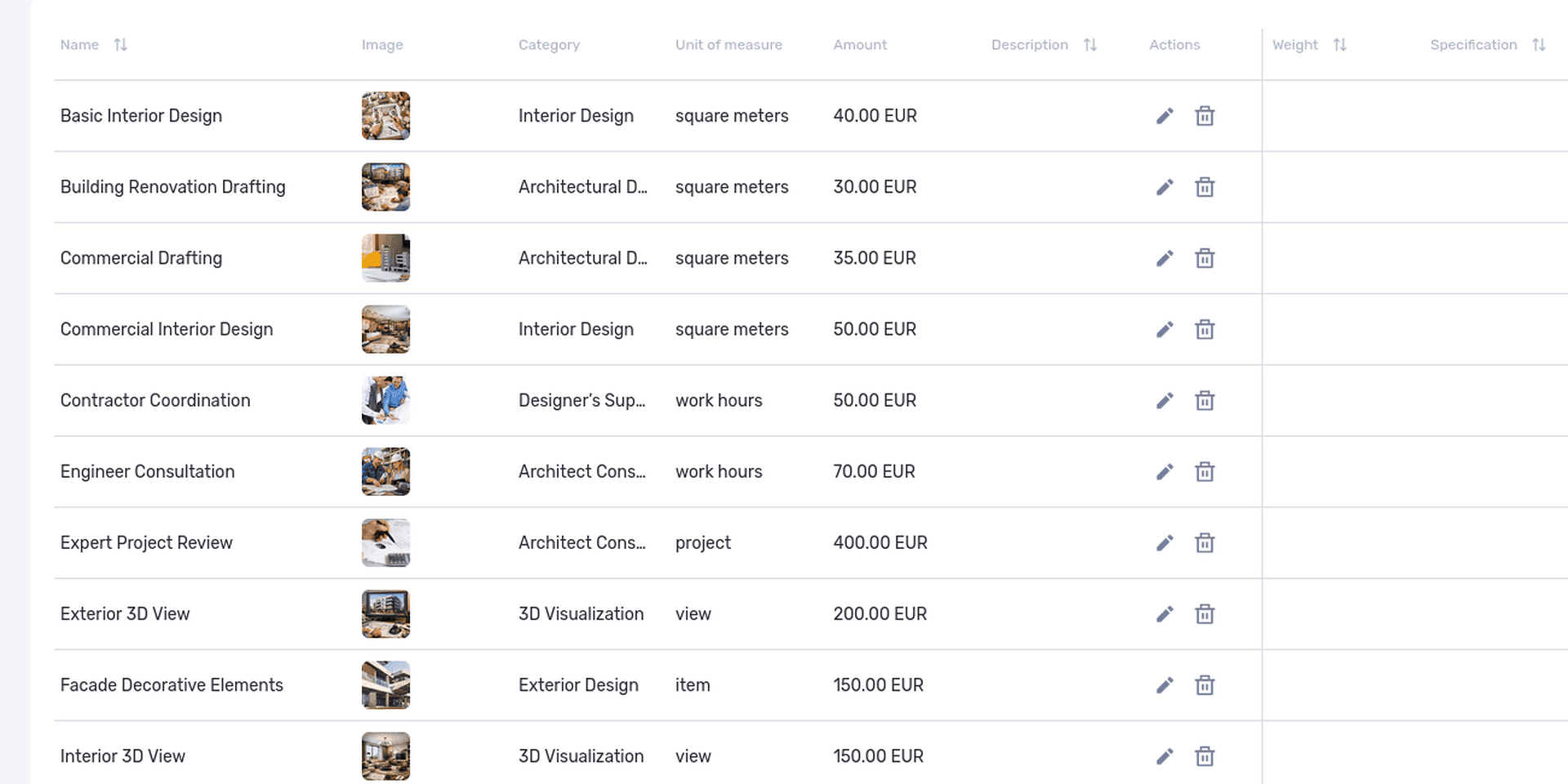
The catalog stores reusable products and services for preparing proposals.
Create the quote and check its line items
Select + in the module. Enter the title, contact, status, currency, and responsible people. Add the description and relevant files. Select catalog items in the table, then check quantities, prices, and discounts. If currencies differ, check the exchange rate too. Select Create when finished. The quote creation guide explains the fields.
For Obrii, a suitable title is “Catalog website · Obrii · v1.0.” The calculation contains the five agreed stages totaling $12,000. Prepare the deliverable descriptions, timeline, and exclusions for the description field and client document.
Don't leave the content-entry line as just $1,000. Keep the explanation that it covers 30 products using prepared materials. Otherwise, a colleague returning to the proposal will see the price without knowing what it includes.
Compare the table with the agreed scope: are all stages included, are quantities correct, and have any optional extras accidentally entered the main total?
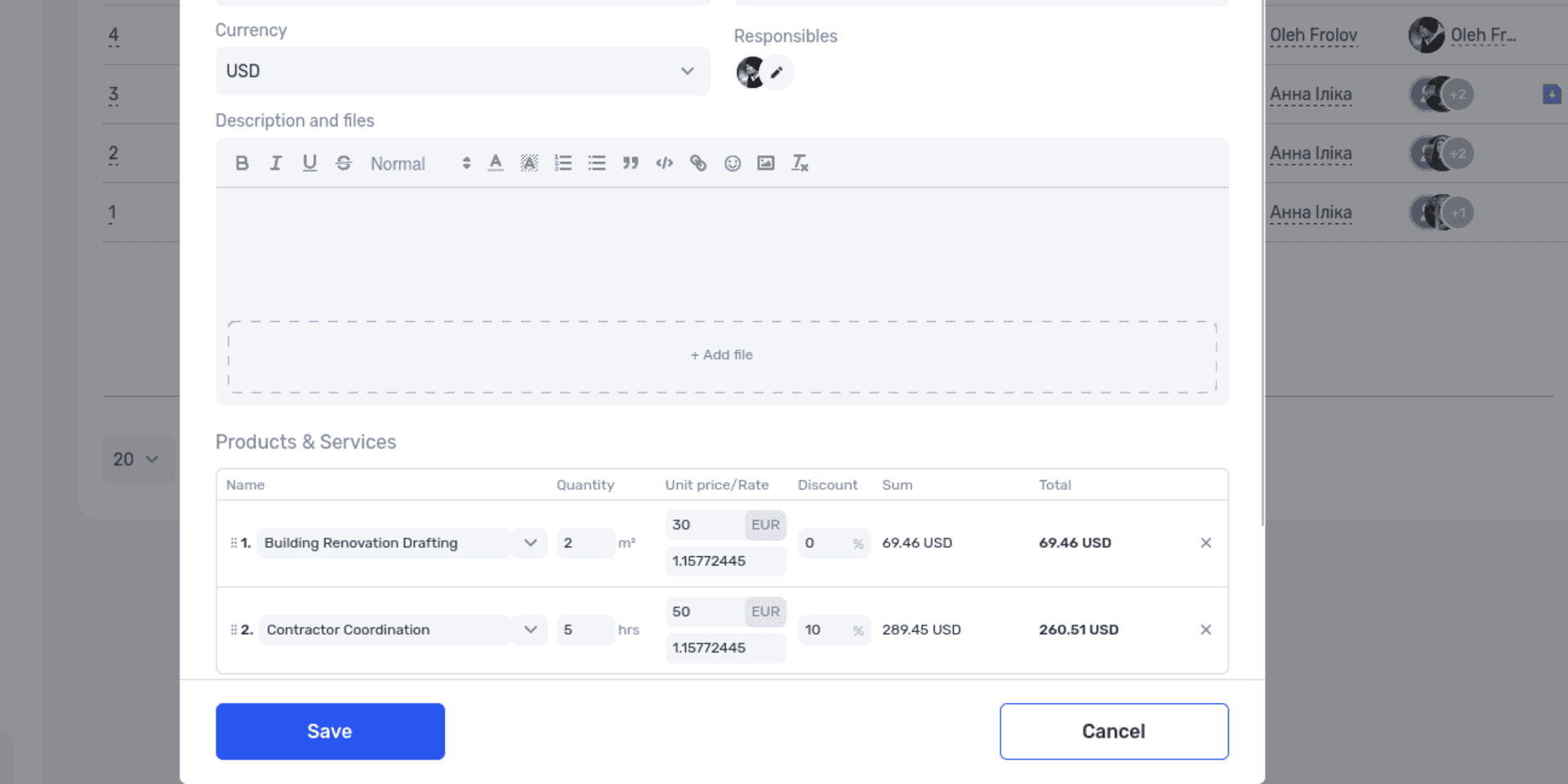
Check the proposal's line items, quantities, prices, and totals.
Link the proposal to a lead or project
Open Quotes in the lead card and add the relevant record. The project form has a corresponding section. Several quotes can be linked to a lead or project, keeping alternatives for the same job together. For how to manage an inquiry from first contact to approval, see our guide to CRM systems.
In our example, the manager saves the proposal alongside Obrii's inquiry. If the client requests a second language, the team prepares another option and explains the difference. Mark which version is under discussion and which is no longer current.
When the job moves from sales to delivery, the project manager needs the approved version, source materials, and unresolved questions. The lead card documentation explains the workflow. The key is to hand over the same scope the client reviewed and approved.
Generate a document using the company template
if.team can generate a DOCX or PDF from a quote using its data and a company template. To add a template, upload a formatted DOCX in the admin panel with variables that insert data from the system. The process is described in the quote document generation update.
Start with your document structure: summary, line items, terms, and contact details. Use the available system variables for the fields to be populated. Copy the exact variable names from the settings rather than guessing them.
Open the generated file and read it as a client would. Check that the data has been inserted, titles aren't cut off, and the total matches the calculation. Correct errors in the data or template and generate the file again.
Keep the current version and track the discussion
The Quotes list shows statuses, totals, responsible people, and links to other records. You can also search by name or copy a quote for a similar job. Copies include descriptions, files, and line items, so review all of them before reuse.
Agree on a manual filename convention using the client, subject, date, and version. For example: “Obrii-site-2026-10-09-v1.pdf.” Keep the file sent to the client separate from the document still being edited.
After a change, record a short summary: second language added, schedule changed, or agency-led content entry removed. Don't silently overwrite earlier terms so colleagues cannot explain the new total.
The approved calculation may also be useful for later documents. Linking a quote to a transaction allows its line items to be used when generating invoices and completion certificates from templates; the cross-module links documentation describes this workflow. A quote total does not, by itself, mean the money has been received.
How to send a business proposal
Before sending, open the exact file the client will receive. Check the first page, tables, and final terms. Another company's name or an old price can be easy to miss while editing a template.
In the email, remind the reader of the context, summarize the essentials, and suggest a next step. Don't repeat the whole document, but don't send an unexplained attachment either.
Sample email accompanying a proposal
Subject: Catalog website proposal for Obrii
Hi Olena,
I'm sending the proposal following our conversation. It covers an English-language website with five page types and a catalog of up to 30 products. The price is $12,000, with a planned timeline of six working weeks from the agreed start, once we have the required materials.
The document breaks down the stages, payments, and exclusions. Please note the content-entry requirements: the estimate assumes your team will provide the copy, photos, and product spreadsheet.
Does this scope match what you need? If so, could we meet briefly on Tuesday at 11:00 to review the materials and agree on a start date? If that time doesn't work, please suggest another.
Thank you,
Forma account manager
This is an illustrative email. Replace the name, day, time, and contact details before sending. If a meeting is already arranged, refer to it rather than proposing a new time.
Sample partnership email
Subject: Catalog websites for your studio's clients
Hello,
We help companies build catalog websites, from the initial structure through to launch. We saw that your studio develops brand identities for manufacturers and would like to discuss working together on the website side of those projects.
We can join once the identity is approved and work alongside your team. Before starting, we agree on the scope, responsibilities, and how we will communicate with the client.
Do you receive requests for this kind of work? If so, I'd be happy to send a relevant example and arrange a short conversation.
Before sending, verify that the studio actually works with manufacturers. If you have another reason for reaching out, explain it. A concrete connection between your work and theirs helps the recipient decide whether a conversation is worthwhile.
What to do if the client doesn't reply
Ideally, agree before sending when you will revisit the proposal. Your follow-up can then refer to a shared plan: “We agreed to return to the proposal on Thursday. Have you had a chance to review the scope, or is there anything I can clarify?”
If no date was agreed, choose a reasonable time based on the complexity of the decision and your previous communication. Ask whether the project is still active and what is preventing a decision. Silence does not automatically mean the price is too high.
If the client says it is expensive, ask what they are comparing it with. Another proposal may omit content entry, equipment, or some of the checks. If the available budget really is lower, suggest a scope change and show what the client would still receive. Discounting without reviewing costs can make the job unprofitable. Our P&L guide explains principles that help assess the financial result.
Mistakes that make a proposal harder to approve
After editing, check that the description, calculation, and schedule agree. Inconsistencies often remain after a template is copied or the scope changes.
The price doesn't match the described scope
The text includes two languages, but the estimate covers one. Delivery appears in the table, while a later paragraph says it costs extra. These contradictions make the client ask questions about terms that should already be clear.
Read the document as one complete transaction: what is the client ordering, what will they pay, and what will they receive? Label optional items and check whether they are included in the total.
The timeline ignores the client's involvement
The team promises a one-month launch even though it needs materials and several approvals. After the first delay, nobody knows what happens to the promised date.
State the start conditions and how the schedule will be reviewed. That lets both sides discuss the actual effect of a delay rather than argue about what “in a month” meant.
Generic copy hides important conditions
If the template contains services the client did not request, they may assume those services are included. Support, warranties, revision allowances, and additional delivery formats are common examples.
Review every promise separately from the cost estimate. The delivery team should see the proposal before it is sent and confirm that it matches their capacity and estimate.
The agreement never becomes a work plan
The sale is complete, but the delivery team receives only a project name and budget. It then has to gather requirements again or starts work that was never included.
Hand over the approved document, source materials, and unresolved questions together. Turn stage deliverables into actionable tasks. Our guide to setting tasks explains how to define expected results and acceptance criteria.
Checklist before sending a proposal
Set the document aside briefly, then read it from the perspective of someone who wasn't in your meetings. Can they understand the offer, price, and conditions without an explanation from the account manager?
- The client name, contact, and subject are correct.
- The stated task reflects the discussions, and assumptions are explicit.
- Scope and stage deliverables can be verified.
- Quantities, units, and prices are consistent.
- The total matches both the calculation and payment schedule.
- Currency, tax treatment, and separate costs are clear.
- The timeline has a defined starting point and accounts for client dependencies.
- Revisions, additional work, and exclusions are specific.
- Support and warranty terms have not been copied accidentally from an old template.
- The file contains the current version, required appendices, and a next step.
- The person responsible for delivery has checked the scope and timeline.
Test the process with a real inquiry and prepare a proposal in if.team: assemble the line items, check the calculation, generate the document, and save it alongside the client's request. One complete cycle will reveal which fields and templates should be standardized for the team.
Frequently asked questions about business proposals
How long should a business proposal be?
Long enough to support a decision. A simple service may need only a short email and calculation. A complex project requires stages, specifications, and conditions. If there is a lot of detail, keep the essentials in the main document and put technical information in clearly named appendices.
Can you send a proposal without a price?
Yes, for an initial conversation or a task that is not yet defined. Explain what you need to estimate the work and when the estimate will be available. If the client has already supplied requirements and is choosing a supplier, omitting the price leaves a central part of the decision unresolved.
How do you write a proposal when the scope is still unknown?
Label the estimate as preliminary and list the assumptions. If needed, propose a separate survey, discovery, or requirements stage. Don't present an approximate amount as a fixed price for undefined work.
What file format should you use?
PDF is convenient for preserving the layout. DOCX is appropriate when the parties have agreed to work with an editable document. If you send a link, check access and make sure the client sees the correct version. Use the format that suits the agreed approval process.
How is a proposal template different from a completed example?
A template provides the structure and spaces for information. An example shows how those parts work together in a particular situation. Reuse the structure, but check the content, calculations, and terms for your own proposal.
Should you include information about your company?
Yes, when it helps assess your suitability: relevant experience, the proposed team, a responsible contact, or details the client requires. A long company history should not push the solution, price, and schedule out of view.
Can you use one proposal for every client?
The structure, design, and standard service descriptions can be shared. Check the task, scope, quantities, price, timing, and exclusions for every inquiry. Even similar projects can require different levels of effort.
What should happen after the proposal is approved?
Save the approved version, agree on the documents needed to commission the work, and hand over the scope, schedule, materials, and open questions. The project plan should contain specific deliverables and owners. That turns the client agreement into a basis for delivery. To track deadlines and budget once work begins, see our guide to project dashboards.
Author
Vladyslav ChesnokovPublished
Oct 6, 2026
More articles to read
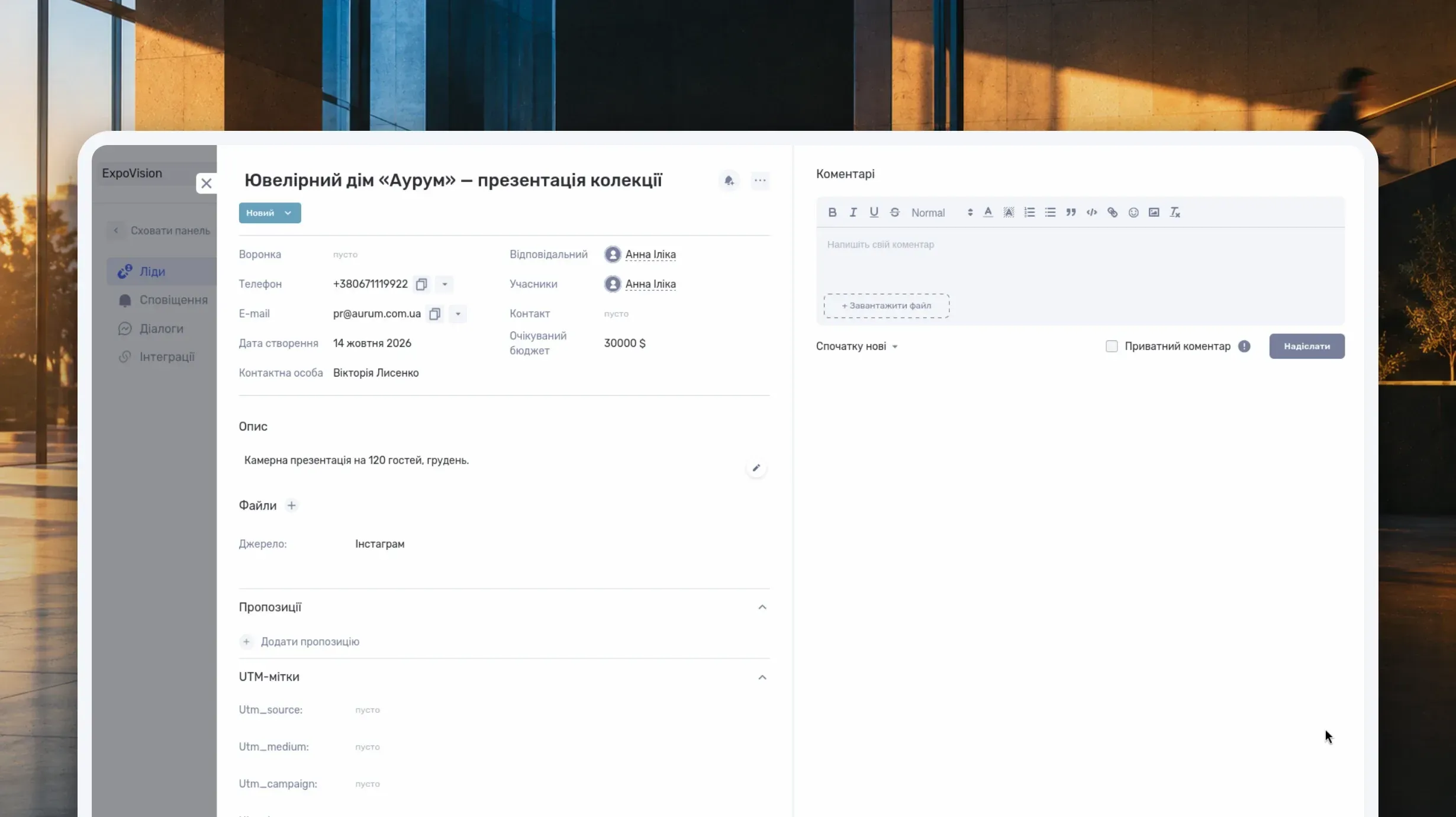
What Is a CRM System and How Do You Use It to Manage Customer Relationships?
Learn what a CRM system is, how it works from first inquiry to outcome, and which features matter day to day. Compare CRM with spreadsheets, task managers, and ERP, and see how to choose a CRM and manage clients in if.team.

What Is a Project Dashboard? Metrics, Example and Setup
Learn what a project dashboard is and how it differs from a report, a spreadsheet, or a Kanban board. See how to choose project metrics, structure the dashboard, and use it in meetings, with a website launch example and setup steps in if.team.
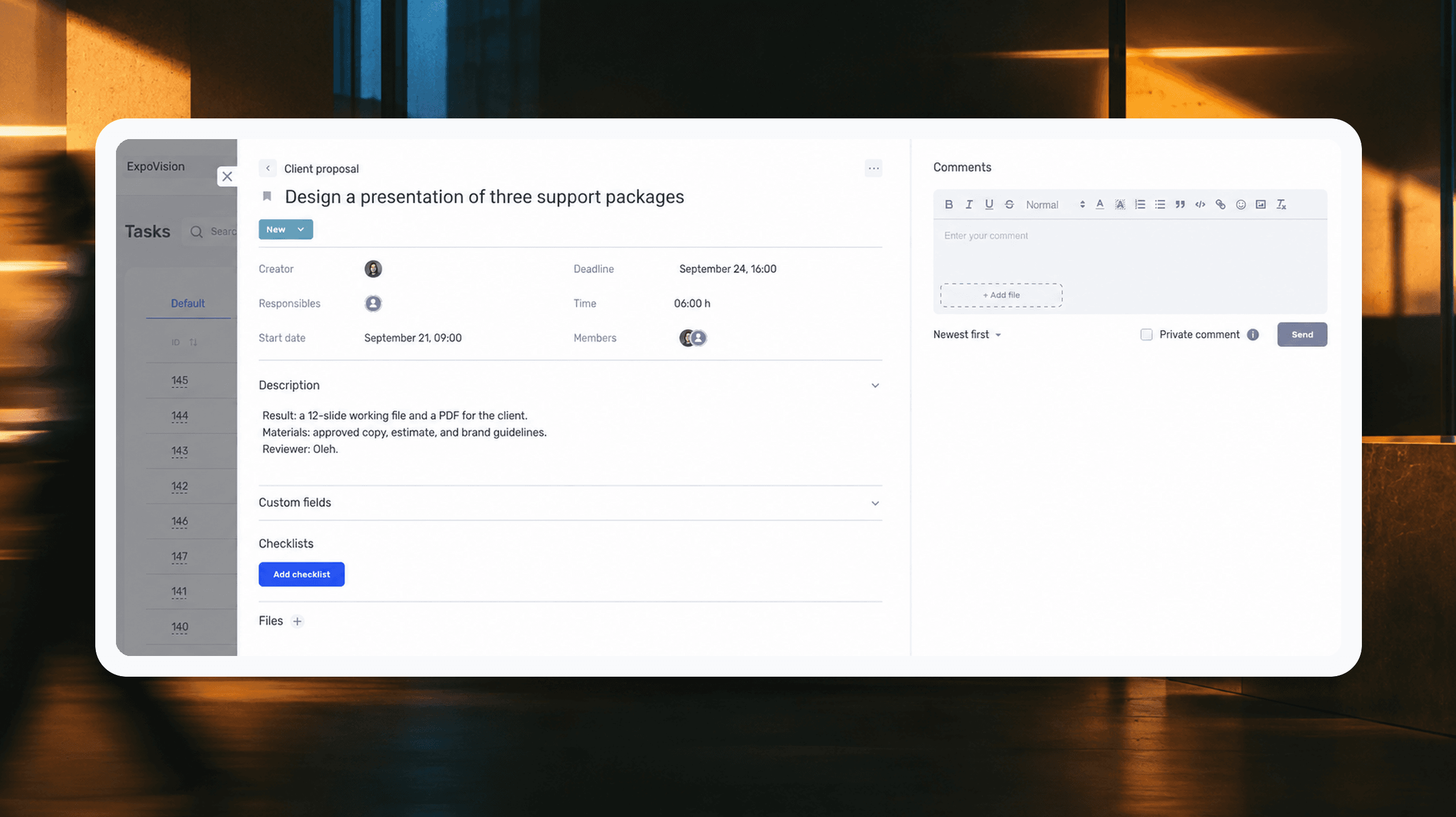
How to assign tasks to your team: from briefing to tracking completion
We break down how to assign tasks so they actually get done: what a brief must contain, how to word the result and the deadline, who takes ownership and how to check completion. With an example, an acceptance checklist and a template for running the task in if.team from start to finish.
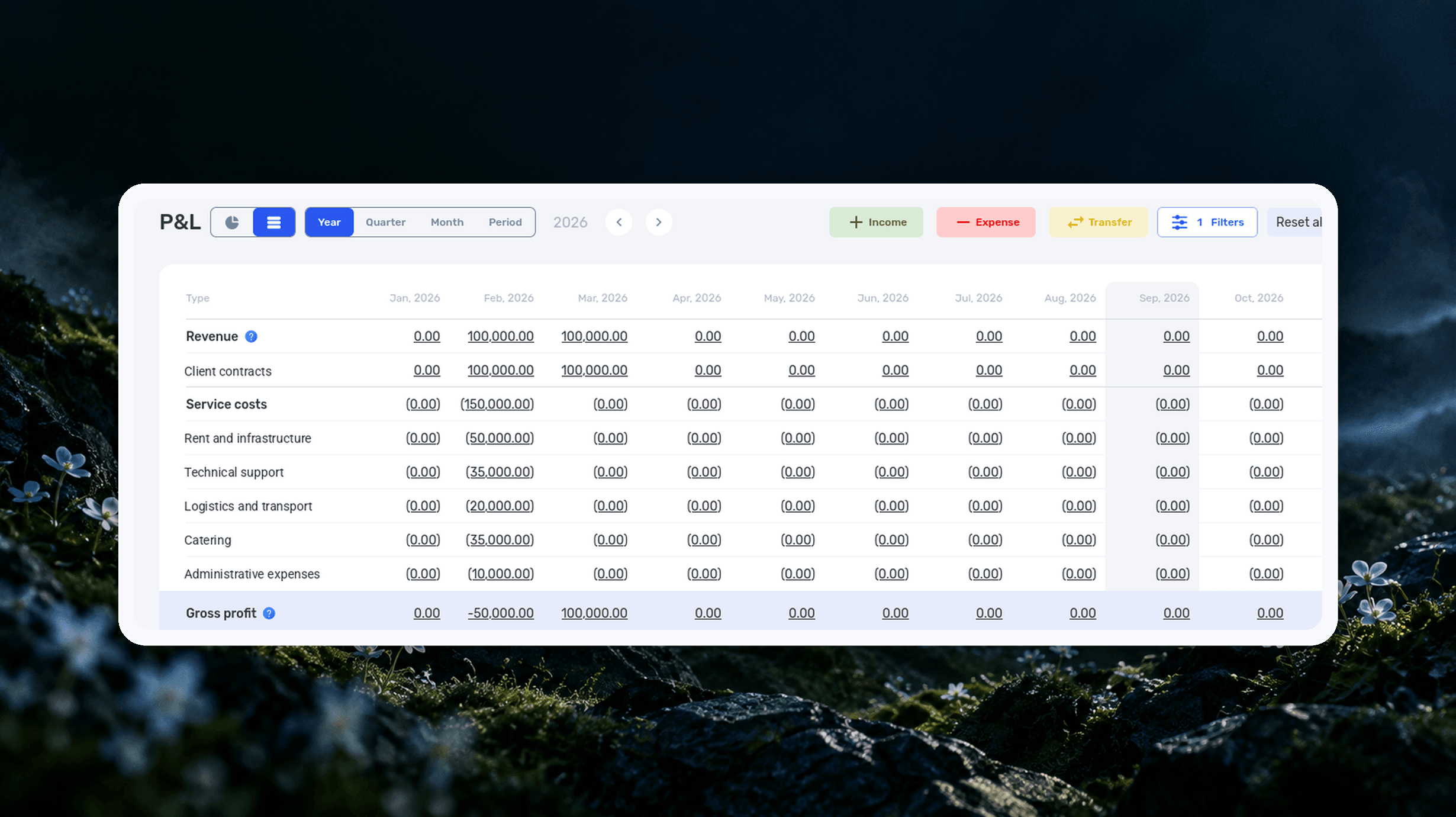
Profit and Loss Statement (P&L): What It Is, How to Prepare and Analyze It
We explain what a profit and loss statement is, how it differs from Cash Flow, and why profit is not the same as the cash left in your account. We break down the P&L structure from revenue to net profit, walk through a calculation for a service company and show how to build your first report.

What Is a KPI in Simple Terms: Examples, Formulas and How to Measure It
A KPI is a number that shows whether you are moving toward a goal and tells you what to do next. Ten KPIs for project-based teams with formulas, a filled-in KPI passport and a worked example of a design studio.

What a Bottleneck Is in Business and How to Identify It
A bottleneck in business is the point where a process actually slows down. Not formally, but in reality. This is where tasks pile up, waiting time increases, and the entire system starts working more slowly than it could. It can be a specific person who physically cannot handle the workload. It…
See if.team in action for your company
We’ll show how projects, team time and finances connect in one system, using your processes as an example.