
What a Bottleneck Is in Business and How to Identify It
A bottleneck in business is the point where a process actually slows down. Not formally, but in reality. This is where tasks pile up, waiting time increases, and the entire system starts working more slowly than it could. It can be a specific person who physically cannot handle the workload. It…

A bottleneck in business is the point where a process actually slows down. Not formally, but in reality. This is where tasks pile up, waiting time increases, and the entire system starts working more slowly than it could.
It can be a specific person who physically cannot handle the workload. It can be an approval step that takes several days. It can be equipment with limited capacity or a rule that makes it harder for tasks to move forward. It doesn’t matter what it looks like — what matters is that this exact point determines the speed of the entire process.
No matter how much you speed up other parts, the overall result still runs into the bottleneck, the narrow point. This is the main constraint that sets the speed limit for the whole process.
As long as the bottleneck remains unchanged, scaling does not work. You can improve things around it, but that will only produce local effects, not overall growth.
What the Term “Bottleneck” Means in Business and Its Definition
The meaning of the term “bottleneck” in business is literally clear from the metaphor of a bottle’s neck. Even if the bottle itself is wide, the outflow speed is determined by the narrowest part. In business processes, this means that one operation or constraint becomes a compression point and limits the throughput of the entire chain. This basic definition of a bottleneck in business aligns well with how the concept is described in manufacturing systems and process management.
In operational management practice, a bottleneck is often described as the weakest link in the system — the single element that, given current resources, prevents producing or servicing more. This is where queues or work in progress (WIP) most often accumulate, and attempts to speed up other steps increase accumulation but do not increase output.
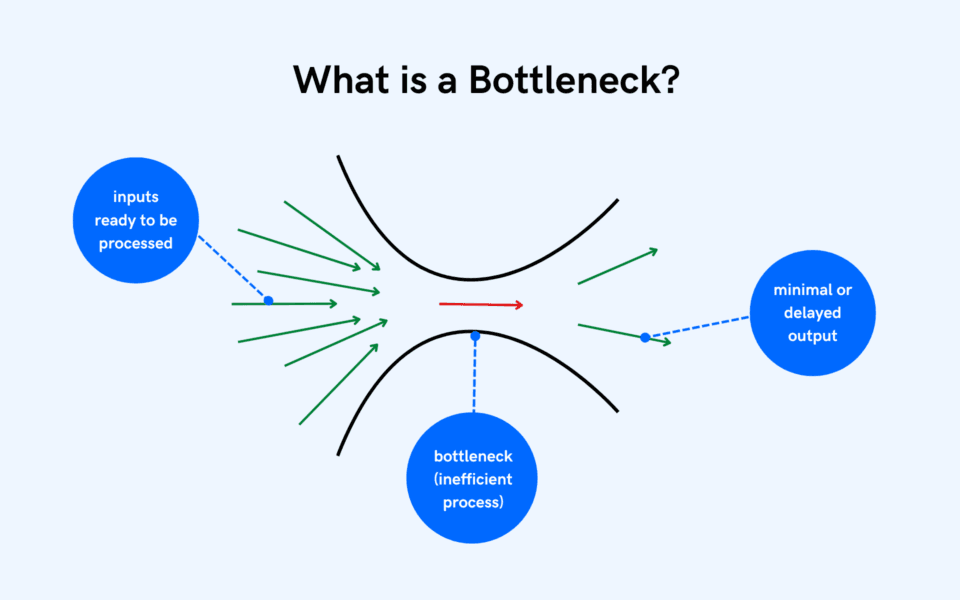
There is an important clarification without which the definition of a bottleneck in business is often oversimplified incorrectly. Bottlenecks and system constraints are sometimes treated as the same thing. But in the Theory of Constraints (TOC), a constraint is not always a piece of equipment or a specific person.
A constraint can be a company rule, a lack of market demand, or a weak point in the function that turns demand into real orders. That is why a bottleneck in business is not only equipment or a specific person. It can be an approval step, a queue to a lawyer, or scarce raw materials.
Distinguishing a bottleneck from a simple problem is easy. If you loosen the actual narrow point, the overall result changes. You start doing more in the same amount of time, closing tasks faster and meeting deadlines more consistently.
If you improved something but the overall result did not increase, you made a local improvement but did not touch the bottleneck.
Types of Bottlenecks
A bottleneck in a process is the point where demand consistently exceeds or nearly equals available capacity. In this zone, work in progress begins to accumulate, the queue grows, and the total process lead time increases. This is where the system hits its limit.
Below is a practical classification that is convenient for middle managers and analysts.
Important: this typology is not mutually exclusive. For example, a long approval can simultaneously be human (one manager), process-related (extra loops), and informational (an incomplete document package).
Why Bottlenecks in Business Processes Determine Speed, Cost, and Quality
It’s easier to think about a bottleneck if you imagine a process as a queue. There is a simple rule from queueing theory, often called Little’s Law. If work moves through the system more slowly, it stays inside the process longer, and more of it accumulates.
So when throughput through a business bottleneck is low, tasks live longer in the system and work in progress increases. This is what is often called WIP — work in progress.
When flow hits a bottleneck in business, a company almost always pays three times:
- With time. Lead time increases due to waiting in front of the narrow step.
- With money. Operating costs grow due to rework, manual expediting, overtime, expediting fees, and penalties.
- With quality. Under queue pressure, error rates and missed checks increase. Even basic definitions describe this as a congestion point that creates delays and raises costs.
In the Theory of Constraints, processes are viewed through three simple concepts.
- The first is throughput — the flow of money. How much money the business actually earns from sales per day, week, or month. Not how much was produced or how many tasks were closed, but how much was earned through sales.
- The second is inventory — including work in progress. This is money currently stuck in the system. It includes raw materials, finished goods in storage, unfinished tasks, and queues, including WIP.
- The third is operating expense. This is the cost of running the process itself. Salaries, rent, energy, contractors, support — everything you pay to turn inventory into sales.
An important point is that improvement does not always increase results. If you speed up the wrong place — not where the bottleneck in business is — the result will be different. Costs increase, more tasks or inventory accumulate in the process, but sales revenue does not grow. The bottleneck remains the same, and it sets the ceiling the system cannot exceed.
The practical takeaway is this: trying to load everyone to the maximum does not guarantee a healthy process. Often the opposite happens. When you accelerate non-critical resources, they simply push more work into the queue in front of the business bottleneck. The queue grows, tasks stay longer in the system, and the sense of control disappears.
For a manager, this looks like a paradox. Everyone is busy, calendars are full, messages are nonstop — yet deadlines and customer promises are collapsing. Often this is visible even without analytics: constant urgent tasks, rework, stress, and everything revolving around one stage. In terms of the definition of a bottleneck in business, this is a classic signal that the process is being optimized locally rather than managed through the system constraint.
Now the same thing in numbers, without magic. Little’s Law gives a simple logic. Average time in system = average amount of work in system / average output rate.
Suppose a team closes 100 requests per week on average. At any moment, there are about 400 requests in progress or in queue. Then the average time a request lives in the system is roughly 400 / 100 = 4 weeks.
Now imagine that the bottleneck in business degrades and the team can release only 80 requests per week. If the amount of work in progress stays the same — the same 400 requests — the average time becomes 400 / 80 = 5 weeks.
This is not the author’s opinion and not complex theory. It is simple arithmetic: slower output with the same queue always produces longer lead time.
Types of Bottlenecks in Business: Physical, Policy, and Market Constraints
To keep bottleneck management in business from boiling down to hiring more people, it is useful to classify bottlenecks by their nature. In TOC, constraints are often divided into two types: physical and policy constraints. This is not about state politics. It is about internal company rules.
A physical constraint exists when you genuinely lack capacity. There is a resource or operation that simply cannot do more per unit of time. For example:
- a single machine or production line with a hard limit;
- one person with a rare skill without whom work cannot move;
- warehouse constraints where there is no space to hold inventory;
- a narrow delivery channel that passes less than required.
A policy constraint exists when flow slows down not because of physical scarcity, but because of how work is organized. A rule may once have been convenient or necessary for safety, but now it simply creates delays. Typical examples:
- approvals without which nothing moves;
- batch processing once a week instead of daily;
- a ban on parallel steps even when it is possible;
- signatures only from the director, even for small items.
This distinction matters because the solutions are different. A physical constraint sometimes really is fixed with more resources. A policy constraint is often removed by changing a rule — cheaper and faster than hiring.
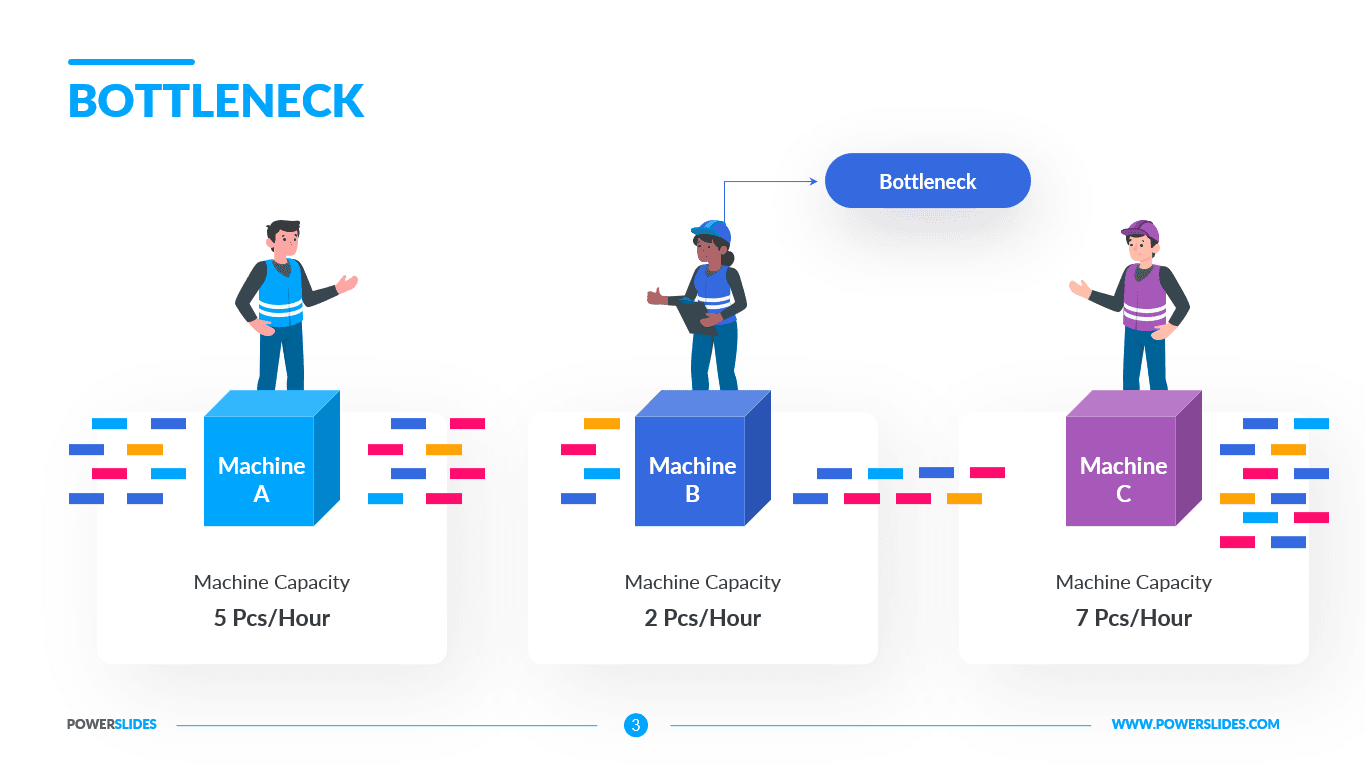
TOC also emphasizes that a constraint does not have to sit inside the process itself. Sometimes the bottleneck is market demand or the way sales turn inquiries into orders.
That is why in service and digital companies, the bottleneck in business is often at the input — demand generation, pricing, or the sales funnel — rather than on the operational line.
From a business-process perspective, it is also convenient to group bottlenecks by where they live in the value chain:
A common mistake is to assume that the bottleneck in business is simply the longest step. Sometimes this is true, but not always.
Long steps may run in parallel and not reduce total output. Short steps can block the entire process if a rule forces everyone to wait for a signature or approval, creating cascading delays. That is why defining a bottleneck in business must rely on flow and accumulation, not just operation duration.
How to Identify a Bottleneck in Business: Data, Process Maps, and Process Mining
To understand how to identify a bottleneck in business, it is best to proceed step by step: describe the process, measure the flow, find where accumulation occurs, and then test the impact — whether overall output grows and lead times improve. This reduces the risk of optimizing noise instead of the constraint.
Process Mapping and Value Stream Mapping as a Base Level
Start with a process map. Simply capture how work actually flows: the steps, inputs and outputs of each step, who is responsible, what rules govern task transitions, and what exceptions exist. This is useful even in digital processes, because such maps often surface things that are invisible in day-to-day work — for example, rework loops and manual actions that no one counts as separate steps.
Next, add value stream mapping (VSM). Its essence is to view work as the movement of materials and information to the customer, not as a set of tasks in a task manager. The most valuable part of VSM is that it forces you to separate two types of time: active work time and waiting time. Bottlenecks in business most often appear in waiting. The queue grows in front of the narrow step even if it looks like there isn’t much work happening there.
To make VSM a decision tool rather than a pretty diagram, add at least three numbers to each step:
- active work time — how many minutes or hours the task is actually being worked on;
- waiting time — how long it sits idle between steps;
- queue before the step — how many tasks are waiting at the door of this stage.
With these three numbers, it becomes clear what eats lead time and where accumulation is largest. Vendor guides on VSM analysis explicitly recommend these metrics to quantitatively identify delays and find bottlenecks in business processes.
Metrics That Most Often Highlight a Bottleneck in Business
To see a bottleneck in business through numbers, four metrics are usually enough: total output per day or week, start-to-finish time, active work time at the step, and work in progress and queues. In documentation, these are often called lead time, cycle time, and WIP, but the idea is simple. If queues grow while output stays the same, tasks inevitably live longer in the system.
For manufacturing and physical processes, OEE is often added — a measure of how much of planned time was truly productive. For demand-driven processes, it is useful to calculate demand rhythm, often called takt time. If your cycles do not fit this rhythm, a bottleneck already exists or is almost inevitable.
Process Mining as Proof of Reality
When a process is digital and lives in a CRM, ERP, or Service Desk, manual mapping often produces a nice but inaccurate picture. People describe how it should work, not how it actually works. In such cases, log-based process analysis — process mining — works well. It does not ask opinions; it looks at system facts.
Process mining is described as an approach that helps discover, monitor, and improve real processes based on data from event logs. Simply put, you take records from information systems and see the real request paths, real delays, backflows, and deviations from the ideal scenario. That is why it is a powerful tool when you need to identify a bottleneck in business based on facts. You can see where accumulation grows, where loops repeat, and which transitions break the process.
To make process mining actually answer the question of how to identify a bottleneck in business, it helps to define data questions before pulling logs. Otherwise, it is easy to collect everything and drown in details. Usually, a few very practical questions are enough:
- Where is waiting time the largest?
- Which transitions have the most returns to a previous step?
- Where is variability the highest, with similar cases behaving very differently?
- Which case segments clog the system, such as specific request types?
These questions keep the analysis focused and quickly point to what truly consumes lead time.
Next, it is worth running a short validation that the bottleneck in business has been identified correctly. This does not require complex math — it requires causality.
- Define the unit of flow: an order, request, batch, trip, or container.
- Record total system output over time and see how it fluctuates by day or week.
- Look for where WIP or queues consistently grow, or where waiting time is highest.
- Test causality. Temporarily relieve the suspected step and see whether total output increases and lead times shrink.
This is the key validation of a correct bottleneck definition in business. If total output does not change after relief, you likely touched something adjacent, not the bottleneck. After changes, measurements should be repeated, because bottlenecks in business often migrate. Remove one narrow point, and the system runs into the next.
Examples of Bottlenecks in Business: Real Cases and Numbers
Below are examples of bottlenecks in business at different levels — from infrastructure to production chains. This matters because a narrow point can exist in your shop floor, in a delivery channel, or in a scarce component.
The Ports of Los Angeles and Long Beach as a Bottleneck for Global Supply Chains
From mid-2021, massive congestion of container ships at anchor formed. On average, around 30 vessels were waiting at any given time, and in August 2021 the number rose to a record 60–80. This is a clear bottleneck in business: the input — arriving ships — exceeded the output, the port’s throughput capacity, creating queues and delays in the supply system.
This does not stay a port-only problem. When a bottleneck appears in infrastructure, the wave propagates down the supply chain. Companies face component shortages, rising freight costs, extra storage expenses, and losses from downtime. Studies on port delays show that congestion was one of the factors behind delivery failures during post-pandemic disruptions. That is why a logistics bottleneck easily scales and impacts entire industries.
The Panama Canal and Climate Constraints as an External Bottleneck
When a bottleneck in business is created not by a company but by nature and infrastructure, management shifts to scenarios and alternative routes. Due to drought, the administration reduced the maximum number of daily transits. Reports mention a reduction to about 31 ships per day versus the normal 36–38. This is a direct reduction in the capacity of a step in a global process — a classic external bottleneck.
Materials on traffic note that after a period of strict limits and gradual recovery in 2025, transit numbers fluctuated again, for example averaging about 32.6 ships per day in January 2025. Higher tariffs pushed some cargo owners to reroute shipments. For companies, this means a bottleneck in business can change not only timelines but the economics of the entire chain.
Semiconductors: Wafer Shortages as a Bottleneck in Technology Chains
In 2021–2022, many manufacturers faced a bottleneck in a very specific node of the chain — wafer fabrication capacity. Semiconductor RFIs cited concrete numbers: median customer demand for chips was up to ~17% higher in 2021 compared to 2019, while median inventories fell from about 40 days to less than 5 days. The same summary explicitly named the primary bottleneck — silicon wafer manufacturing capacity. This is a case where the bottleneck is not final assembly but a base component that sets the limit for the entire process.
The report explains why such bottlenecks are hard to remove quickly. Capacity expansion requires massive investment and long lead times. It mentions approximate factory costs for advanced semiconductors at the level of $10–20 billion. Structural risks from production concentration and complex supply chains are also highlighted. This means some bottlenecks in business cannot be fixed through internal discipline alone. They require strategic decisions, supplier portfolio work, contracts, and proper risk management.
Aircraft Manufacturing: Supplier Quality as a Bottleneck in High-Complexity Industries
In complex industries, bottlenecks in business often hide not in speed but in quality. Aircraft manufacturing is a clear example. Materials note that over the last two years, the supply chain has noticeably stabilized. The company spends about 40% fewer hours fixing supply issues compared to 2024. At a key supplier, defects dropped by roughly 60% after quality controls were strengthened.
The point is that defects at a bottleneck do not merely slow the process. They trigger extra work loops: rework, reinspection, waiting for replacements, and schedule shifts. Quality problems at the narrow point multiply delays and make the entire process less predictable.
Retail Fulfillment: Picking as a Warehouse Bottleneck
In warehouse logistics, a bottleneck in business often arises in picking, because it involves a lot of manual work, high order variability, and strict accuracy requirements. Automation provides a clear example. Reports describe robotic systems packing a significant share of orders, mentioning tens of millions of shipments and a robotic packing share of about 40% at the time. This illustrates the investment logic: companies increase capacity exactly where the bottleneck limits overall fulfillment output.
Managing Bottlenecks in Business: What to Do After Diagnosis
Once you understand how to identify a bottleneck in business, the most common mistake is to immediately buy tools or hire people. TOC proposes a sequence that reduces the risk of spending money without changing total output. First, identify the constraint. Then exploit its current capacity as much as possible. Next, subordinate other steps to this rhythm. Only after that do you increase the constraint’s capacity. Then repeat the cycle, because bottlenecks in business often shift.
Exploit: Get the Maximum Without Investment
Exploiting a bottleneck in business means eliminating losses at the narrow point: downtime, setups, defects, late inputs, unnecessary approvals, and unnecessary product variants. In manufacturing, this often boils down to two things: the bottleneck must never wait for material, and it must not drown in unnecessary batches.
In service processes, bottleneck management often looks like standardizing the most frequent cases, preventing input errors, and reducing rework. Bottlenecks may be caused by people, policies, or supporting resources, and request classification and contact analysis help uncover causes of repetition and time loss.
Subordinate: Synchronize the Rest of the Process to the Bottleneck
Subordination means that everything that is not a bottleneck supports the constraint and does not create excess WIP. This is why work-release rules matter: WIP limits, prioritization, and service classes. In VSM and Lean logic, this is about reducing waiting and inventory that do not add value.
If you have a demand rhythm, subordination means planning to it rather than to maximum utilization. The rhythm is calculated as available working time divided by customer demand, and it helps align production with real demand. This is useful for bottleneck management because it provides a reference against which actual cycles are compared.
Elevate: Invest Only After Discipline
Elevation is what most teams do too early — buying equipment, adding shifts, automating, outsourcing. In TOC, this is step four because without prior exploitation and subordination, investment often goes to waste. In such cases, the bottleneck either does not disappear or simply moves into defects, approvals, or logistics.
It is important to remember that capacity increases are not always capital-intensive. For a policy bottleneck, the investment is often a rule change: an SLA for signatures, delegated authority, or automatic approval for small amounts. For a market bottleneck, the solution may be a shift in product focus, pricing, or channel.
The idea that constraints include not only production steps but also demand or sales capability points to a simple conclusion: sometimes the problem is not people, but the absence of strategy.
What a Bottleneck Is in Business and How to Lock in Results
A bottleneck in business, in practical terms, is the point that limits total system output and therefore accumulates work. You see it as a queue or as growing WIP. The key point is that a bottleneck is always tied to flow. You must look for where accumulation appears consistently, not occasionally, and what exactly blocks work from moving forward. That is why bottlenecks often match what is colloquially called a traffic jam and what TOC describes as the weakest link worth focusing on.
The most reliable definition of a bottleneck in business emerges when you combine three things.
- First, a process map showing steps, transitions, and exceptions. Process mapping and VSM are useful here — you can name them once in English and then continue in your native language.
- Second, numbers. You look at total output per day or week, start-to-finish time, and the size of queues and WIP. This anchors conclusions in facts rather than impressions.
- Third, system data, if available. When the process is digital, event logs show real paths, rework loops, and waiting points.
This approach reduces the risk of optimizing noise instead of the constraint and helps find the bottleneck in business where it truly affects results.
To lock in the effect and avoid losing it to cosmetic improvements, use a short bottleneck management checklist:
- First, define the system and the unit of flow. This may be an order or a request. Do not start with a single department — bottlenecks often sit at interfaces.
- Validate bottlenecks through impact on total output, not through where it is “loudest” or where everyone is busy.
- Track WIP and waiting time before steps. Accumulation is almost always the most stable signal of a narrow point.
- Start with exploit and subordinate. Move to elevate only when it is clear results will not shift without investment.
- Remember that bottlenecks in business can be physical, policy-based, or market-driven. Solutions must match the nature of the constraint.
- Measure again after changes. Bottlenecks usually move, especially when capacity at the narrow point is genuinely increased.
If you need a simple control point, it is this: a bottleneck in business processes is identified correctly when you can show with data that this specific step or rule limits total system output — and that changing it produces a visible effect. That effect may be shorter lead times, more reliable delivery of promises, or lower costs. This practical definition works regardless of industry — ports and logistics, high-tech manufacturing, or digital services.
Author
Vladyslav ChesnokovPublished
Feb 17, 2026
More articles to read
How to assign tasks to your team: from briefing to tracking completion
We break down how to assign tasks so they actually get done: what a brief must contain, how to word the result and the deadline, who takes ownership and how to check completion. With an example, an acceptance checklist and a template for running the task in if.team from start to finish.
Profit and Loss Statement (P&L): What It Is, How to Prepare and Analyze It
We explain what a profit and loss statement is, how it differs from Cash Flow, and why profit is not the same as the cash left in your account. We break down the P&L structure from revenue to net profit, walk through a calculation for a service company and show how to build your first report.

What Is a KPI in Simple Terms, What It’s For, and How to Evaluate It
What is a KPI in simple terms? It’s one number or several numbers that show whether you’re actually moving toward a specific goal. Not how many actions you took, but whether a result appeared. A KPI isn’t for reporting. It’s for managing work. You look at the indicator and understand what exactly…

RACI Matrix: Simple Explanation, How It Works, and Use Cases
The RACI matrix helps teams quickly agree on who does what in a project: who performs the work, who is accountable for the final result, who provides expertise, and who needs to receive updates. When these roles are defined upfront, it becomes easier to align decisions and coordinate actions.…
Gantt chart: what it is, why you need it, and how to build a simple working format
In this guide, we’ll break down what this format is, the types of Gantt charts, how to work with them, and how to build a simple online version. No fancy terms or unnecessary decoration. Only what helps you plan.

What is a Kanban board: a simple explanation of the system, method, and principles
One of the first and most effective such systems was kanban. This method combined simplicity and discipline. It doesn’t replace people or add unnecessary bureaucracy — it simply helps reveal what used to be hidden in the chaos of daily work.
Start your free 7-day trial
No credit card required. Get full access to all features and see how if.team can transform your team's workflow.