
How Ukrainian Business Brotherhood manages members, subscriptions, and business club operations in if.team
A business club revolves around its members. The team maintains the member database, tracks subscriptions, organizes events, coordinates internal tasks, and keeps information about how people take part in the life of the community.
A business club revolves around its members. The team maintains the member database, tracks subscriptions, organizes events, coordinates internal tasks, and keeps information about how people take part in the life of the community.
As the community grows, so does the amount of information the team has to manage. Some of it relates to members, some to events and projects, and some to the team’s day-to-day work. Over time, separate spreadsheets, contact lists, and task managers make connected processes harder to follow.
This is especially noticeable in a business club, where a member’s subscription, event participation, communication with the team, and the internal work behind those events are closely connected. Ukrainian Business Brotherhood uses if.team to keep that information connected.
The team uses the system to maintain its member database, track subscriptions and activities, and organize the club’s internal work.
About Ukrainian Business Brotherhood
Ukrainian Business Brotherhood is a private business club for Ukrainian entrepreneurs. The community brings business owners together around growth, collaboration, and joint initiatives.
The Brotherhood runs business and educational events, meetups, trips, and other formats that bring members together. Social and charitable initiatives are another part of its work.
That variety creates a steady flow of parallel processes. Members join the club, renew their membership, attend events, interact with the team, and take part in shared initiatives. At the same time, the organization is constantly preparing new activities and coordinating the work behind them.
The team needs an up-to-date member database, clear subscription statuses, accessible interaction history, and a structured way to manage internal processes. Ukrainian Business Brotherhood uses if.team as a shared workspace for this day-to-day work.
How Ukrainian Business Brotherhood manages members
For a business club, the member profile becomes one of the core working points. It stores the information the team needs to understand each relationship and quickly find the right details.
In if.team, Brotherhood members are stored as individual contact profiles in a single database. This gives the team a shared foundation for managing membership, subscriptions, and activities.
One member database for the business club
Each member has a dedicated profile with the information the team needs for day-to-day work. This makes it easy to move from the full member list to the details of a specific person.
The profile can be adapted to the club’s processes with custom fields, so the team can store the data that actually matters for membership management.
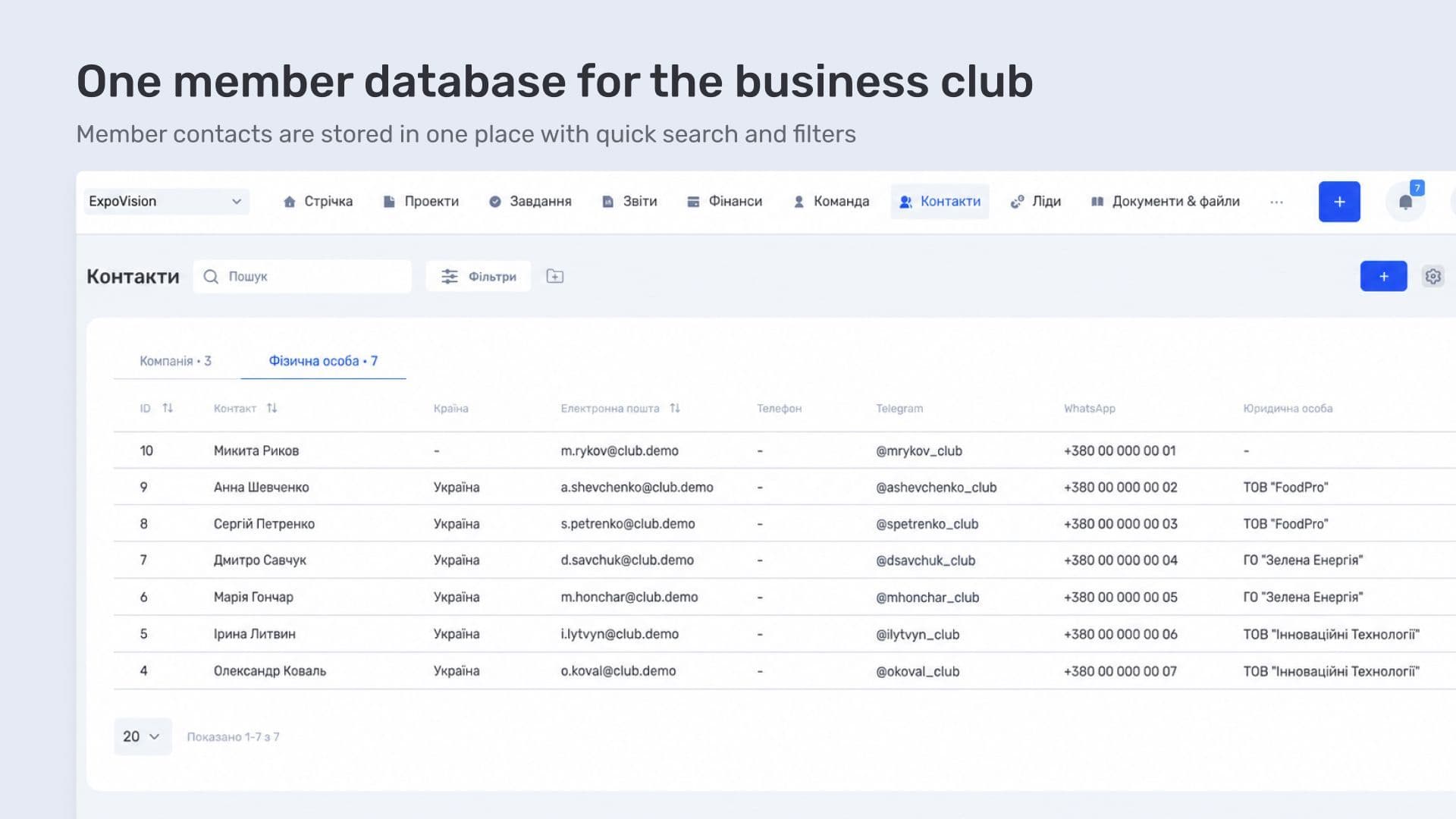
A shared database also reduces manual searching. The team can check and update member information faster and use it directly in the workflows that follow.
As a result, member information stays current and accessible to the whole team, making the data easier to find and use in daily operations.
Subscriptions and participation in the community
Member subscriptions are also tracked in if.team.
Subscription details are stored alongside the rest of the member’s information, so the team can see the current membership status in the same place where it manages the relationship.
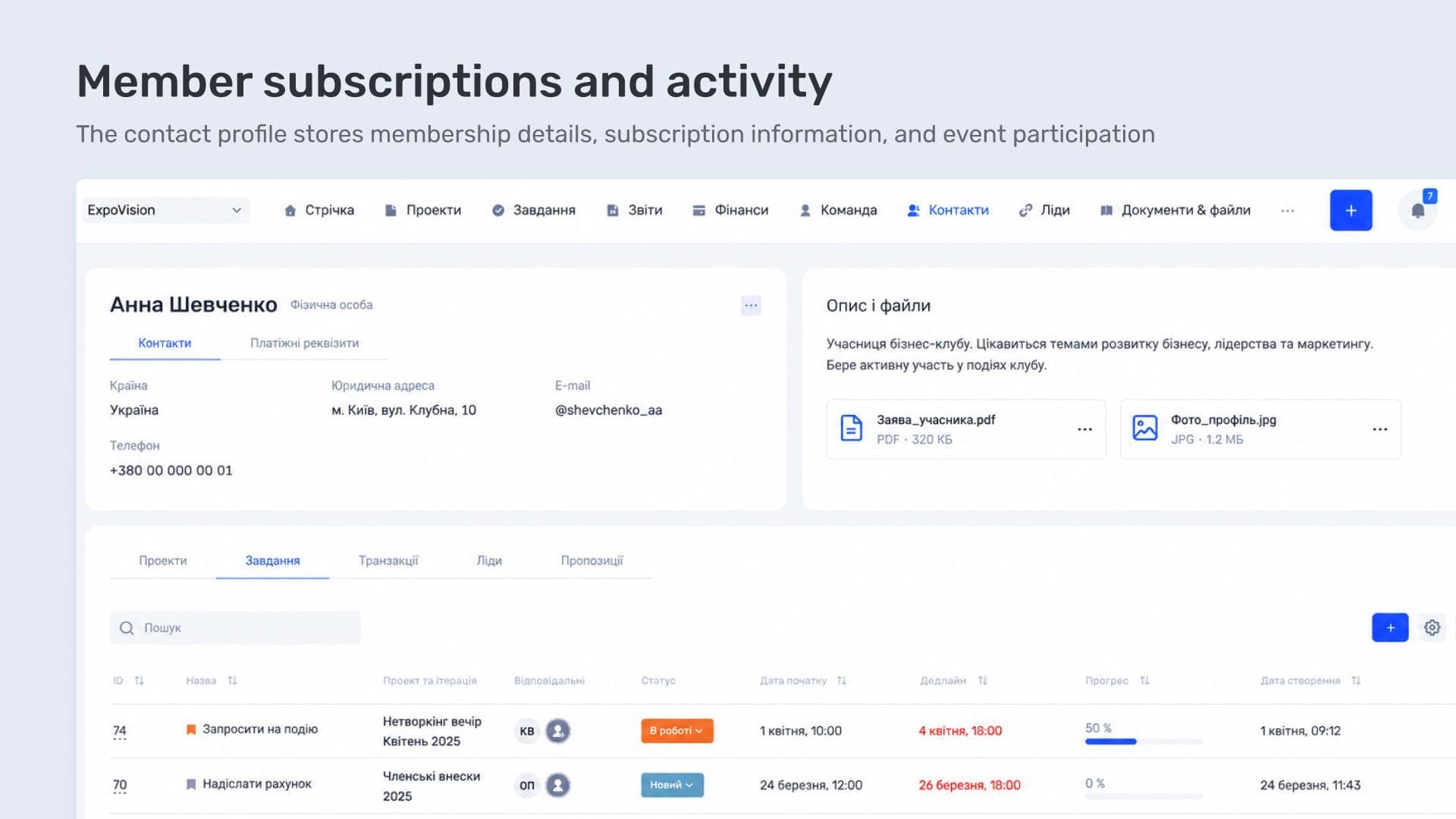
For a business club, this is one of the core workflows. Membership status is closely tied to what comes next: event participation, communication with the team, and other activities within the community.
The contact profile can also store information about a member’s participation in Brotherhood activities. For a club with regular events, this keeps the history of interaction with each member in one place.
The database therefore becomes a practical tool for managing the community. The team can see the relevant member data, update it as things change, and use it throughout its ongoing work.
How the team organizes business club operations
Alongside member management, the Brotherhood team runs the club’s internal processes: preparing events, working on individual initiatives, coordinating owners, and tracking tasks.
These processes are closely tied to the life of the community. A single event can involve the agenda, attendees, vendors, venue, communications, and dozens of smaller organizational details.
This work is also managed in if.team, keeping community data and internal operations connected.
Events and activities
Each event consists of many connected actions: preparing the program, communicating with members, handling organizational tasks, working with vendors, and keeping deadlines under control.
The team uses projects in if.team to manage this work. A project brings the related tasks together, assigns responsibility, and gives the team a clear view of the overall preparation process.
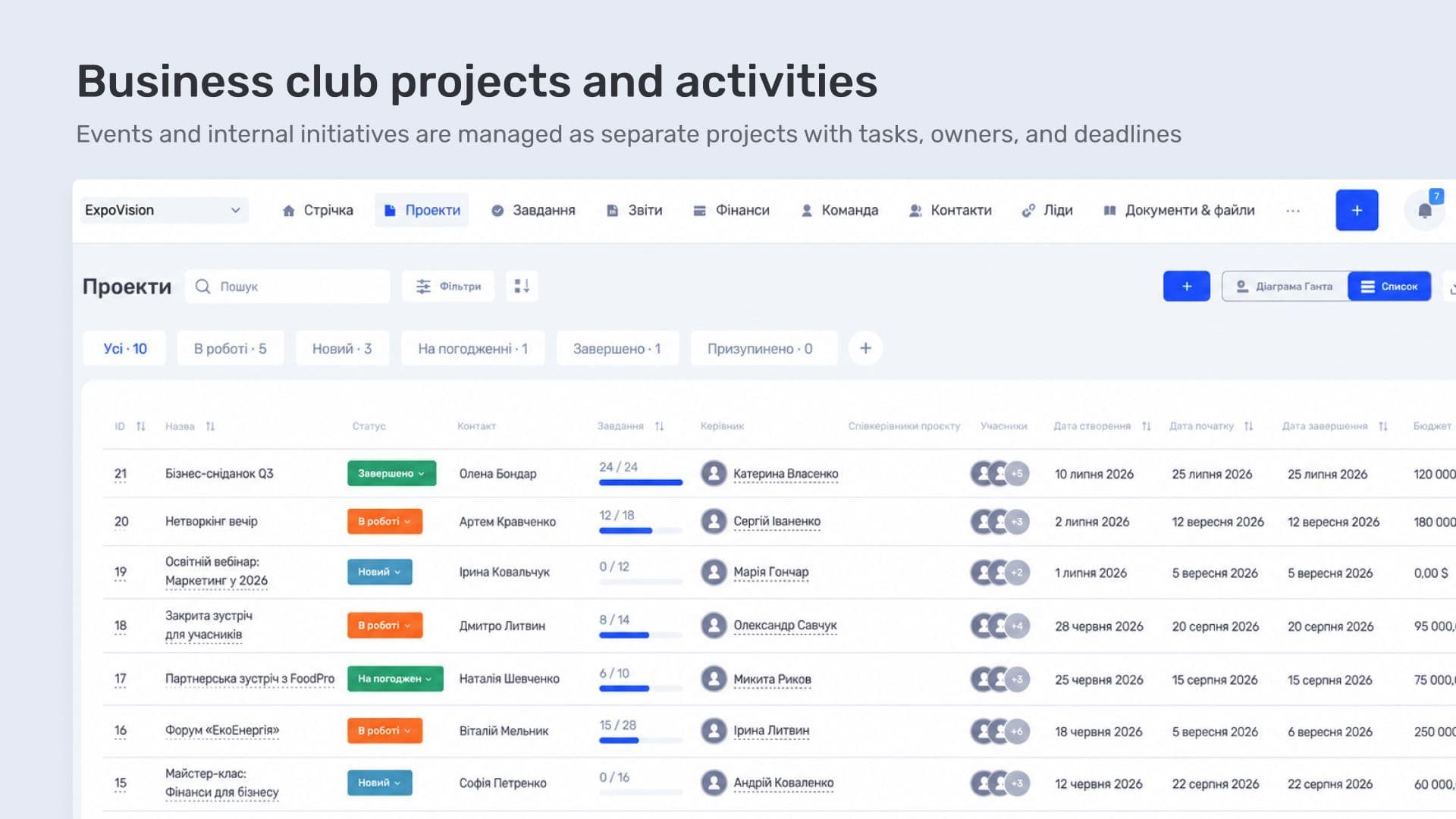
Each activity gets its own workspace, where the context of the preparation stays together and the team can move from the overall plan to individual tasks.
The same structure works for other club activities that need dedicated coordination, keeping the related information and work inside one project.
Tasks and ownership
Work inside each project is broken down into specific tasks. Each task can have an owner, deadline, and the details the team needs to get it done.
While an event is being prepared, dozens of smaller processes may move in parallel. One person may handle the program, another communications, while others work on the venue or logistics. When several activities are happening at once, a structured view becomes especially important.
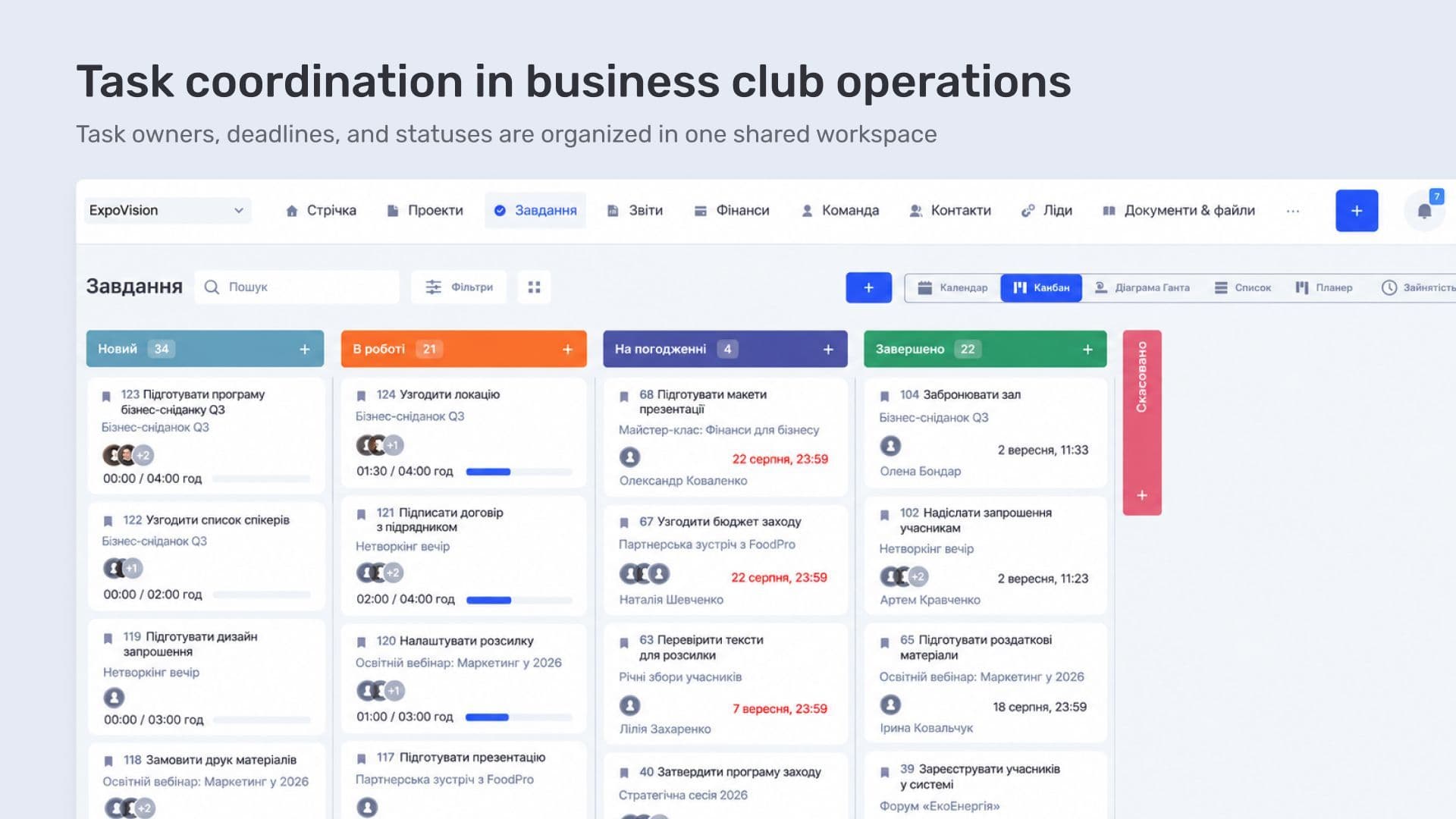
Tasks stay tied to the relevant project, so the team sees them in the right context. This makes coordination easier and gives everyone a clearer picture of the current state of preparation.
At any point, the team can see what is done, what is still in progress, and who owns each step.
How if.team helps a business club manage members, subscriptions, and day-to-day operations
For Ukrainian Business Brotherhood, if.team brings several layers of day-to-day work together.
The team uses the system to manage its member database, track subscriptions and community participation, organize events, handle tasks, and coordinate internal processes.
The key advantage is shared context. Member information sits alongside the work happening around the community, so profiles, subscription statuses, activities, and internal processes all live in the same workspace.
For the team, this means quicker access to current information and a clearer structure for day-to-day work. When preparing an event or working with a specific member, there is no need to reconstruct the context from several different sources.
The Brotherhood also uses project and finance functionality in if.team, while this case focuses on member management and the organization of the business club itself.
A separate area of Ukrainian Business Brotherhood’s work is its charitable foundation. The foundation also uses if.team, with a stronger focus on project and financial management. We cover that workflow in a separate case study.
Author
Vladyslav ChesnokovPublished
Sep 7, 2026
More articles to read
How a Ukrainian charity foundation manages projects and finances in if.team ERP
In a Ukrainian charity foundation, finances are closely tied to individual projects. Funds come in for different initiatives, expenses have their own structure, and the team needs a clear view of both each project budget and the foundation’s overall cash flow.
How Urban Reform Manages Projects, Teams, and Finances with if.team ERP for Nonprofits
Ukrainian nonprofits often begin with a small team and one specific problem they want to solve. Some support internally displaced people and veterans, while others work in education, culture, or community development. As they grow, so does the volume of day-to-day operational work.
ERP Software for Nonprofit Organizations: Transparent Finances and Reporting for YEP! Accelerator
YEP! Accelerator — a startup accelerator that understands this better than anyone. They were among the first to implement if.team. Thanks to the platform, they were able not only to organize their finances but also take their operations to a new level.
How Creatura manages event projects, budgets, and finances in if.team ERP for event companies
How if.team ERP for an event company helps Creatura manage event projects and budgets, receive transactions from PUMB, and automatically create folders in Google Drive.

How KiwiParty manages inquiries, prepares estimates, and organizes events in if.team CRM for event agencies
How if.team CRM for event agencies helps KiwiParty manage inquiries from Instagram, Telegram, and WhatsApp, prepare estimates, and plan turnkey events.
How BigShow manages concert projects and finances in if.team ERP for event agencies
How if.team ERP for a concert agency helps BigShow manage concert projects, preparation stages, contractor agreements, and the finances of concerts and the orchestra.
See if.team in action for your company
We’ll show how projects, team time and finances connect in one system, using your processes as an example.